Earlier roof work can be valuable evidence, but only when it can be connected to today’s property conditions. A repair invoice, a remembered service visit, or the age of the roof may help explain the history. None of those facts, by itself, proves why a present concern exists or that replacement is now required.
For an Allen homeowner, the useful approach is to treat earlier work as a case history that must be matched to location and current evidence.
Does the old work actually match today's concern?
Start with the documented location of the earlier work. If the record is specific enough, compare it with today’s exact roof plane, transition, attic area, or interior location.
A location match can make the history more relevant. It still does not prove that the earlier repair failed, that the current condition has the same cause, or that the present entry point is identical.
If the old record is vague, keep the match tentative. “Same side of the house” is not the same as a verified same-location comparison.
The repaired area in its surrounding context
An old repair makes more sense when it is viewed in the context of nearby materials. Compare current material condition, movement, wear, transitions, and visible compatibility around the earlier work area.
The repaired spot may appear different from the surrounding roof, or it may simply be one part of a broader pattern. Either observation can be useful, but neither should be converted directly into a cause finding.
This comparison is especially important before assuming that another local repair is feasible or that replacement is necessary. The current condition of the surrounding system matters more than the existence of an old repair by itself.
Old work should be matched, not generalized
A roof may have more than one repair history. One documented location should not automatically be used to explain a different area simply because both are on the same roof. Keep each earlier-work record tied to the location it actually describes.
When the exact match is uncertain, note the uncertainty before using the history in today’s scope discussion. That helps prevent a vague repair history from being turned into a claim that the roof has a general pattern of failure.
The surrounding roof is the control for that comparison. If the repaired area is behaving differently from nearby materials, that difference deserves attention. If the surrounding roof shows a similar pattern, the old repair may be less distinctive than it first appears. Either result can shape the next question without proving cause or replacement need. When prior work is documented well, it can also show what questions were considered important at the time. Use that information cautiously. Earlier recommendations were made with the evidence and access available then, not with today’s later observations. The homeowner can compare the earlier reasoning with the current condition without assuming the old decision was wrong simply because the roof is being reviewed again. That perspective helps turn repair history into context for today’s scope instead of a backward-looking search for blame.
Weather can be added as a separate comparison layer through an Allen property-level roof review that uses local weather context. That can help identify useful dates for comparison without changing what the earlier repair record actually says.
Recurrence is a question, not an accusation
When a symptom returns near documented earlier work, it is reasonable to ask whether the two are related. Same-location recurrence can justify another inspection and a closer review of the repair strategy.
It should not be written as proof that someone’s earlier work failed. Other materials, adjacent components, concealed pathways, or a different condition may still need to be considered.
A disciplined history says, “This area has been involved before; compare it carefully,” rather than, “The old repair caused today’s problem.”
Gaps in the history stay visible
Older records are often incomplete. A homeowner may not know exactly which materials were used, what concealed conditions were found, or how far earlier work extended. An inaccessible area may also prevent the current inspection from verifying what was done.
Do not reconstruct missing facts to make the history feel complete. If product identity, hidden assembly details, or the exact earlier scope cannot be confirmed, leave those points open.
Those gaps can affect today’s decision because they may limit confidence about compatibility or repair feasibility. But uncertainty is not itself evidence that replacement is required.
Roof age provides context, not a verdict
Age can matter because it provides material-history context. It can help a homeowner ask whether earlier work, current wear, and surrounding conditions fit together.
Age alone does not establish remaining life, failure, cause, repairability, warranty response, or replacement need. The same is true of the number of earlier repairs. A repair count without location and current-condition context is a weak basis for scope.
Use age and repair history to sharpen the inspection questions, not to skip them.
Future discoveries belong in the record
If later access reveals concealed conditions, document what was actually found and where. If that discovery changes the planned work, preserve the reason for the revision.
This turns today’s project into useful history for the future. The next homeowner or contractor should not have to guess why the scope changed or which location was affected.
The record should also distinguish a newly verified finding from assumptions that remain unresolved.
Today's options depend on today's evidence
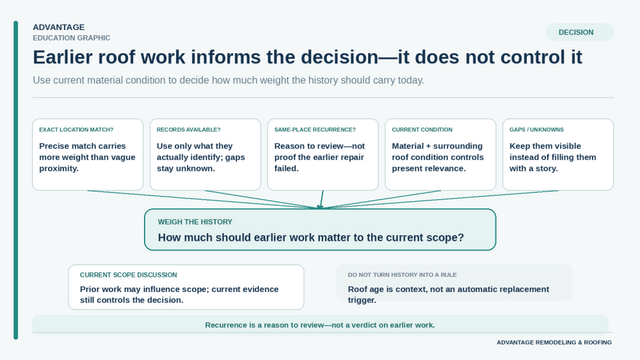
Earlier work is one factor in deciding between repair, replacement, or a scope that includes planned discovery. The current property evidence should remain the center of the decision.
Ask whether the present concern is localized, whether surrounding materials support a focused approach, whether recurrence has changed the pattern, and what inaccessible or undocumented conditions still matter.
A roof history becomes useful when it helps explain the questions. It becomes misleading when it is treated as a verdict. Earlier repairs and aging materials can give an Allen homeowner valuable context, but the current scope should be built from what can be supported today.