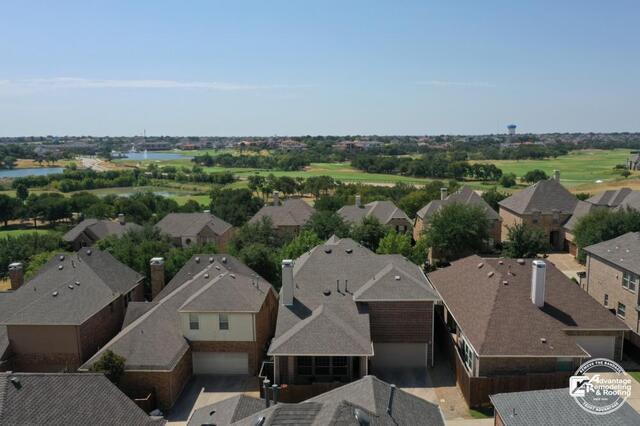
Regional weather can tell an Allen homeowner when it may be worth looking more closely at a roof. It cannot tell you, by itself, what happened to one particular property. A useful review keeps those two information streams separate: regional weather provides timing context, while the home’s own observations determine what is actually present and what deserves further inspection.
The practical task is to move from “weather happened in the area” to “these exact property locations changed, remained stable, or still need to be checked.”
Regional context and property evidence are different kinds of information
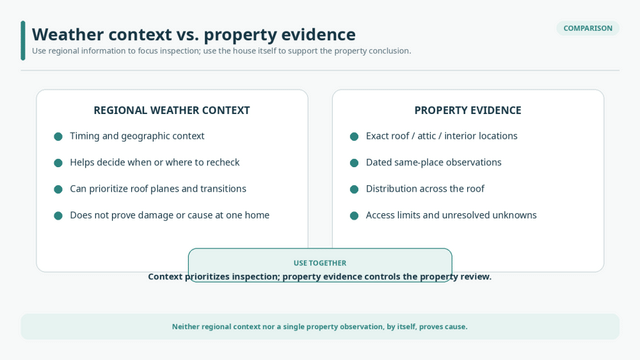
Write down the weather context as context. Then create a separate record of what was observed at the house: location, date, condition, and any related accessible attic or interior observations.
This separation prevents a regional report from silently becoming a property diagnosis. Timing and geographic proximity can help organize an inspection, but they do not prove that a particular roof was damaged or that a particular condition was caused by the event.
If exact property evidence is missing, keep that gap visible rather than substituting the regional report.
Regional context can prioritize inspection without deciding it
Weather information can still be highly practical even when it cannot prove property damage. It can help a homeowner decide when to revisit documented locations, which roof planes or transitions deserve comparison, and whether a same-place symptom changed after a period of exposure.
The key is to keep the inspection question conditional. “This regional weather occurred, so recheck these property locations” preserves the proper relationship. “This regional weather occurred, so this roof condition was caused by it” goes beyond what the regional information establishes.
Property patterns can disagree with the regional story
A home may show an isolated condition where a broad event explanation would suggest a wider pattern, or it may show observations on several orientations with no single obvious relationship. Those differences should remain in the record. They can help the next inspection test whether the initial weather-based theory fits the property at all.
Attic or interior observations may also point toward another explanation or simply leave the cause unresolved. That is not a failure of the weather review. It is evidence that the property itself is controlling the conclusion, which is exactly how the process should work. A property-level weather review can also improve documentation after the initial inspection. Keep the regional context entry separate, then add later same-location observations beneath the property record. If the condition stays stable through later periods, that is useful. If it changes or recurs, the new observation can be compared with the earlier map. Over time, the record becomes a property history rather than a collection of regional weather references.
That history can help a future inspector see which locations have actually changed and which assumptions remain untested, while preserving the core limit that timing and regional distribution alone cannot establish the property-specific cause. That discipline also makes later updates easier, because new property observations can be added without rewriting the earlier regional context as a causal finding.
The distribution of observations across the roof
Location patterns can make the property review more informative. Note the roof plane, orientation, transition, edge, penetration, drainage area, or other repeatable location where an observation appears.
Then look at distribution. Is the condition isolated? Does it appear in several places? Are the observations concentrated on one part of the roof, or are they spread across different planes and transitions?
Distribution can shape the next inspection question. It does not by itself establish a single cause, event, entry path, or required scope.
Dates become useful when tied to the same locations
Chronology becomes stronger when later observations can be matched to the same places. A homeowner can ask whether a condition was present before a weather period, changed afterward, returned later, or remained stable.
That sequence is useful even when it does not identify the cause. A documented change after a weather event still does not prove that the event caused the change.
The goal is to understand the property pattern over time, not to force every date into one causal story.
Exterior, attic, and interior evidence may not tell the same story
When safe access and relevant evidence are available, compare exterior patterns with attic, moisture, airflow, or interior observations. A related location may strengthen the reason for a focused inspection.
It does not prove an unseen pathway. An interior symptom should not be used to backfill a roof cause, and an exterior mark should not be used to assume concealed damage.
Alternative context matters because a property-level review should consider evidence that may not fit the first weather-based explanation.
What regional weather cannot answer
A disciplined review should include its limits. Regional weather cannot establish concealed conditions, exact entry paths, coverage, warranty response, final scope, or outcome for one home.
Access limitations should also remain visible. If part of the roof or attic could not be inspected, weather context does not fill that gap.
Stating these limits makes the review more useful because the homeowner can see which questions still require property-specific evidence.
A changing property pattern changes the review
Before closing the file, define what would justify another look. A same-location recurrence, a new observation on another roof plane, a change in an attic or interior condition, or newly available access can all change the property pattern.
Preserve the dated map so the next inspection can compare the same locations rather than starting over from a general impression.
Allen weather context is most valuable when it tells a homeowner when and where to pay attention. The roof decision itself should remain grounded in the home: exact locations, repeated observations, system context, and clearly stated unknowns. That is how regional information becomes a property-level review without being mistaken for proof of damage or cause.
When the dated map begins to span separate weather periods, it can help to review why multiple storm seasons complicate roof replacement decisions. The same-location record then gives the next inspector something concrete to compare instead of treating each season as a fresh start.