Manufacturer instructions and warranty terms can influence a roof-replacement plan, but only when they are connected to the products and system details that actually apply to the proposed work. General statements about “manufacturer requirements” are not enough. An Allen homeowner should know which product is being proposed, which written requirement is relevant, who is responsible for following it, and which property facts still need confirmation.
That keeps manufacturer information useful without turning it into a promise about eligibility, acceptance, remedy, or future performance.
Product identity comes before general claims
Start with the products and components named in the replacement proposal. Product records are more useful than appearance alone when exact identity matters.
A visible shingle, accessory, or ventilation component may resemble a known product, but appearance does not necessarily verify the exact model, installation history, or concealed system. If the applicable manufacturer requirement depends on precise product identity, confirm that identity through appropriate records rather than assuming it.
This is the foundation for every later warranty or instruction question.
Match the requirement to the part of the system it governs.
Once the proposed product is identified, ask which written manufacturer information applies to that product and the connected components involved in the scope.
A requirement may relate to a local installation detail, material compatibility, ventilation context, accessories, or another system condition. The homeowner does not need to turn every requirement into a separate public checklist. The important question is whether the proposal identifies the relevant requirement and whether the property facts needed to apply it have actually been confirmed.
An inspection gap should remain an inspection gap. Do not fill it with an assumption that the system is compatible or noncompliant.
Visible observations have limits
A visible installation detail can be important. It can show that a specific location deserves comparison with written product information.
It cannot automatically establish whole-system compliance, concealed installation, design adequacy, warranty eligibility, or acceptance. The same caution applies to photographs. They can document what is visible without proving what is hidden.
If a conclusion depends on concealed conditions, the proposal should identify that dependency instead of presenting the conclusion as already verified.
The same product questions make replacement options comparable
When two scopes use different products or system approaches, compare them using the same fields. What exact products are proposed? Which connected components are included? What written requirements are believed to apply? What exclusions remain? Who is expected to confirm an unresolved item?
This makes product differences meaningful. A more expensive product is not automatically more suitable, and a contractor’s confidence is not a manufacturer decision.
The comparison should show how each option fits the property evidence and what still needs confirmation.
Separate manufacturer terms from contractor obligations.
A contractor has responsibilities related to the work being proposed and performed. Manufacturer documents define product-related requirements or terms. A later warranty decision may belong to the issuer under its own process.
Those roles should not be blended together. A contractor can explain how the work is intended to follow the applicable product information and can preserve installation records. That explanation is not the same thing as guaranteeing how a later warranty question will be decided.
Likewise, a documented field change is not proof that an issuer accepted a condition or promised a remedy.
A useful warranty question names the product and requirement
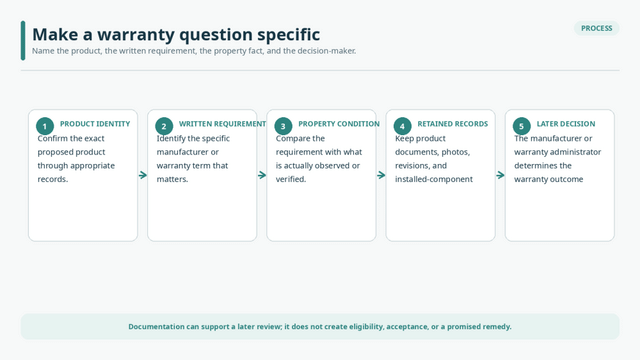
“Will this be covered?” is often too broad to answer responsibly during a replacement discussion. A better question identifies the product, the written term or requirement at issue, the visible property condition that may matter, and the person or organization that ultimately decides the warranty question.
That structure keeps contractor documentation useful without turning it into an issuer decision. A contractor can preserve installation photos, product information, and revisions; those records may matter later. They do not themselves create eligibility or acceptance.
The same discipline helps when a requirement involves ventilation or another connected component. If the relevant property fact has not been verified, the homeowner should see that gap before relying on a general statement that the system “meets warranty requirements.”
Specific questions are more useful because they separate what can be checked now from what only a later decision process can determine. If a proposal refers to a manufacturer requirement, ask to see the specific written information rather than relying on a paraphrase when the requirement materially affects the scope. Then compare the document with the actual proposed product and the property condition that is supposed to matter. If the match depends on a concealed or unverified detail, mark that detail for confirmation. This approach does not let the homeowner decide a later warranty claim; it simply makes the replacement decision more transparent about which requirement is being relied upon and which facts are established today. The homeowner can then compare proposals on specific documented requirements instead of broad warranty language, while leaving future issuer decisions where they belong.
Weather context can be added through an Allen property-level roof review that uses local weather information so dates for reinspection are organized separately from the manufacturer requirement being checked.
Installation evidence may matter later
Keep the relevant product documents, installation photographs, scope revisions, and records showing which products and components were actually used. If an important detail changes during the work, preserve the reason and the updated documentation.
Good records make later questions traceable. They do not guarantee eligibility, acceptance, performance, or a particular remedy.
The value is continuity: a later reviewer can see what product was proposed, what was installed, what visible conditions were documented, and why a change occurred.
Manufacturer instructions and warranty terms should therefore make an Allen roof-replacement decision more specific, not more absolute. Use them to ask precise product-and-system questions, clarify roles, and preserve evidence. Keep unverified property conditions and future warranty decisions open until the appropriate evidence and decision-maker actually resolve them.