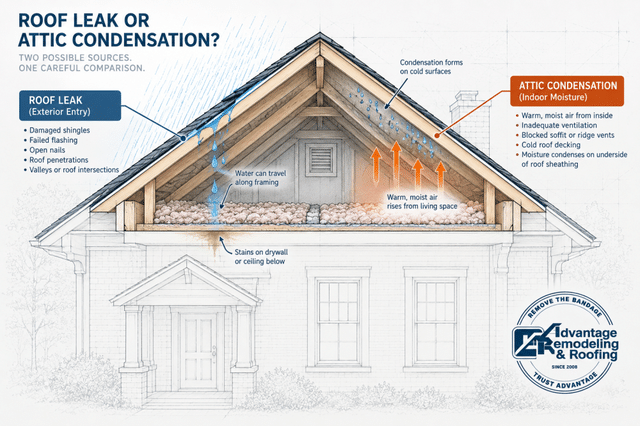
A roof leak and attic condensation can produce similar moisture signs before the source is understood. A stain, damp material, or wet reading can make one explanation feel obvious, especially when it appears after rain or during a period of indoor moisture. The safer approach is to keep both exterior-entry and indoor-moisture pathways open long enough to compare the whole pattern.
When the pattern spans repeated storm seasons, Allen roof-replacement decisions can become more complicated over time. The comparison should also account for what earlier roof work can tell you and the warranty or manufacturer rules that may affect replacement choices, while keeping the moisture source as a separate question.
For an Allen homeowner, that means using location, timing, repeated measurements, airflow, temperature context, insulation, and contradictory observations together rather than letting one clue decide the case.
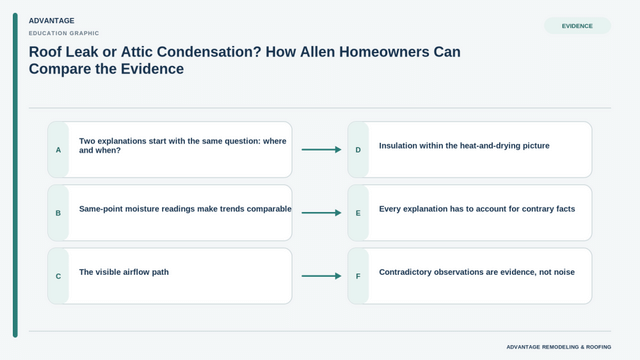
Two explanations start with the same question: where and when?
Map the exact symptom location and record when it was observed. Note relevant weather timing and indoor conditions without turning either into a cause conclusion.
If moisture appears after rain, that timing is worth recording. It does not prove exterior entry or storm causation. If the condition appears during a period that seems compatible with condensation, that does not prove the roof is excluded.
The early record should be neutral enough that either explanation can still be tested.
Same-point moisture readings make trends comparable
One meter value or one damp spot is a snapshot. Repeated readings at the same material and location can show whether the area is wetting, drying, or remaining relatively stable.
The comparison needs consistency. A reading from a different material or nearby location may not mean the same thing. Dates and conditions also matter because the goal is to identify a trend, not to collect numbers.
Even a clear trend has limits. It does not automatically establish the source, concealed pathway, or cause.
The visible airflow path
When condensation remains a possible explanation, inspect the visible airflow context that can be observed safely. Intake and exhaust locations, obstructions, attic geometry, and differences between attic zones may help show whether the condensation explanation deserves continued attention.
An observed gradient or airflow pattern does not prove pressure direction or active condensation by itself. Visual inspection also cannot guarantee that a ventilation design is adequate or that a correction will produce a particular drying result.
The purpose is comparison: does the visible airflow context fit the moisture pattern, conflict with it, or leave the question unresolved?
Insulation within the heat-and-drying picture
Insulation can affect temperature and drying context, so visible insulation conditions may help explain why one attic area behaves differently from another. Covered areas, however, remain partly unknown.
Do not use a visible insulation pattern to infer concealed moisture source or full assembly condition. Treat it as another piece of context that should be compared with the moisture history and airflow observations.
Every explanation has to account for contrary facts
A strong roof-leak explanation should account for observations that seem more compatible with indoor moisture. A condensation explanation should account for evidence that appears more consistent with exterior exposure.
This is where contradictory facts are valuable. If the symptom recurs without the expected weather pattern, note it. If moisture appears in a location that does not fit the assumed airflow explanation, keep that contradiction visible.
Do not rescue a preferred theory by ignoring inconvenient observations. The best working explanation is the one that fits the most property evidence while requiring the fewest unsupported assumptions.
Contradictory observations are evidence, not noise
Suppose moisture appears after one rain event but not another, or a damp attic location does not correspond neatly with the roof location that first seemed suspicious. Those facts may feel inconvenient, but they are exactly what a good comparison needs. They can show that the first explanation is incomplete or that conditions changed between observations.
The same is true for condensation. A visible airflow obstruction may make indoor moisture more plausible, while a later same-place wetting pattern may keep exterior entry open. Neither observation should be discarded merely because it complicates the story.
Follow-up should use comparable conditions
After corrective work, try to compare the same locations and materials using observations that are as comparable as practical. If roofing work is performed, do not treat a dry interval alone as proof that every source question is resolved. If ventilation or insulation work is performed, do not assume a later change proves that condensation was the only earlier pathway.
The strongest follow-up asks a narrower question: what changed at the same location after this specific intervention? That preserves the value of the result without turning it into a broader causal claim than the evidence supports. Indoor conditions can also change between observations, so the moisture history should note meaningful context when it is actually known. That does not require a homeowner to perform a technical building-science study. It simply prevents a wet reading taken under one set of conditions from being compared casually with a later reading taken under another. The more consistent the location and observation method, the more useful the trend becomes. The limits remain the same: a trend can sharpen the source question without proving a concealed pathway or excluding other moisture sources.
Separate corrective steps reveal what changes
If different kinds of work are proposed, keep their purposes distinct. Roofing work, ventilation changes, insulation work, plumbing or mechanical work, and interior repairs may address different questions.
After work is performed, use comparable follow-up observations to see what changed. A reduction in symptoms can be informative, but it does not automatically prove that every earlier causal question has been resolved.
Separating the work also makes it easier to understand which intervention changed which part of the evidence.
The goal is not to make a homeowner diagnose moisture from a checklist. It is to avoid prematurely closing one pathway. By comparing repeated same-place moisture, weather and indoor timing, airflow, insulation, temperature context, and contradictory facts, an Allen homeowner can support a more disciplined inspection and scope decision without letting one stain or one reading decide whether the source is the roof or the attic environment.