A roof-replacement decision reaches beyond the visible roof covering. Materials meet at transitions, water has to be managed toward drainage paths, attic airflow interacts with the assembly, and individual components have to work with the parts around them. For an Allen homeowner, reading the roof as a system means following those visible connections without pretending to know what concealed layers or exact product details have not been verified.
Material identity comes before compatibility
Identify the visible materials and components that can be observed with reasonable confidence. Note where one material meets another, where penetrations or transitions interrupt the field, and where accessories connect with the roof surface.
Appearance can help organize the inspection, but it may not establish exact product identity. A photograph also cannot confirm concealed installation details. If product identity or compatibility matters to the proposed scope, that may require records or written confirmation rather than a visual guess.
The important first step is to know which visible components are present and where their relationships deserve attention.
Connections matter when one clue is not enough
A roof often becomes easier to understand when observations are compared at the same locations across several connected parts. If a surface condition appears near a transition, drainage feature, or attic observation, document the relationship.
If the clues do not line up, that is useful too. A system explanation should account for what fits and what does not. One visible interruption should not be turned into proof of a system-wide failure or a hidden cause.
Connection photos and matched locations can help a later review return to the exact places where the explanation is incomplete.
Read accessible layers together with airflow and drainage.
Where layers or adjacent assembly details are visible, compare them with what can be observed about airflow and water management. The purpose is not to make one clue explain every symptom. It is to see whether the proposed work is considering the connected system rather than only the most obvious surface condition.
Airflow observations can add context, but visual inspection alone does not prove concealed design details or guaranteed performance. Drainage clues can show how visible water-management components relate to the roof, but they do not prove an exact hidden pathway.
Each observation should keep its own evidentiary limit.
When a local component raises a wider system question
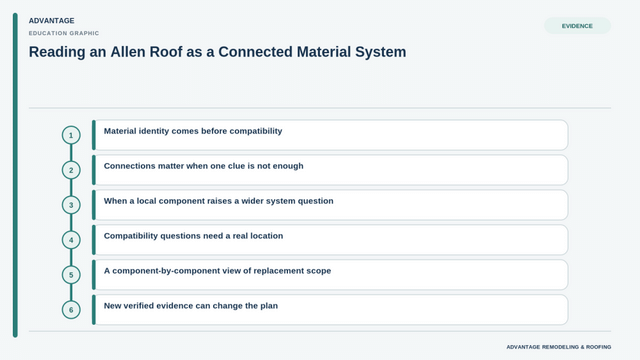
A condition at one transition or accessory does not prove a system-wide problem, but it may expose a relationship that the replacement scope has to address. For example, a local material connection may raise a compatibility question that affects how neighboring work is planned. An airflow or drainage observation at one location may also show that a surface-only explanation is incomplete.
The correct response is not to generalize the local observation across the entire roof. It is to follow the connection far enough to understand what must be confirmed. That may involve another visible location, a product record, a written requirement, or an access point that is not yet available.
This keeps the system review both broad enough to catch connected issues and narrow enough to avoid claiming hidden conditions that have not been verified. A system view also makes omissions easier to see. If a replacement proposal is detailed about the field material but says little about a connected transition, ventilation-related component, or drainage relationship that appears relevant at the same location, the homeowner has a specific question to ask. The answer may confirm that the item is outside the work, show that it is addressed elsewhere in the scope, or identify a fact that still needs verification. The important point is that the connected observation becomes a question for the scope rather than an unsupported assumption about hidden failure.
Compatibility questions need a real location
“Is this compatible?” is more useful when it refers to a specific component or transition. Ask which materials are expected to meet, which requirement is believed to apply, and what still needs confirmation.
If an access gap prevents verification, keep the compatibility question open. Do not fill the gap with an assumed product identity or hidden assembly condition.
This is especially important in replacement planning because a scope may need to coordinate several components. A local observation can justify a local question without becoming proof about the entire roof.
A component-by-component view of replacement scope
When evaluating different replacement options, line up the system parts they address. Which roof materials are included? Which transitions, accessories, ventilation-related components, or drainage-related items are addressed? What requirements are being relied upon? What is specifically outside the work?
A broader scope is not automatically better because it names more components. A narrower scope is not automatically sufficient because the visible symptom is small. The comparison should show how each proposal responds to the connected property evidence.
Ask what would happen if later access reveals a condition that changes the compatibility or system understanding.
New verified evidence can change the plan
Replacement planning can change as access improves. If a concealed layer becomes visible or a component is identified more precisely, the new information may support a revision.
Preserve the reason for that change. Distinguish what is newly verified from what remains unknown. A documented change does not, by itself, prove storm cause, coverage, warranty acceptance, performance, safety, price, or schedule.
The value of a system view is that it makes revisions easier to explain. The homeowner can see how a newly verified component relationship affects the proposed work instead of being told only that “the scope changed.”
Reading a roof as a connected material system therefore means paying attention to relationships while respecting limits. Visible materials, accessible layers, airflow, drainage, and connected components can make a replacement decision more coherent, but product identity, compatibility, concealed conditions, and final outcomes should remain open until the evidence actually confirms them.
When earlier repairs or service work are part of the roof's history, matching that work to today's exact location can reveal whether it is relevant to the current system question.