Trustworthy roof communication is not mainly about polished wording. It is about continuity. An Allen homeowner should be able to follow the written record from the first property observations through recommendations, questions, revisions, and next actions without having to guess what changed or why.
The clearest documents connect what is being proposed to what was actually observed, while keeping unobserved conditions and unanswered questions visible.
The house belongs at the center of the first written summary
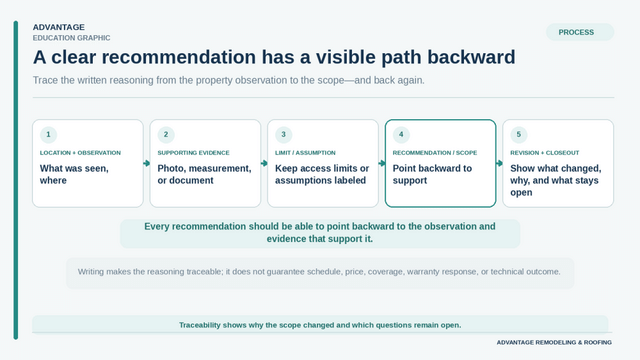
Before a recommendation hardens into a scope, the written record should identify the important property locations, observations, measurements when available, and access limits. It should also name the questions that are still open.
This gives later recommendations something concrete to point back to. A statement such as “replace this component because of the documented condition at this location” is easier to evaluate than a broad statement that simply says replacement is needed.
Clear writing cannot create evidence that was never observed. If an area was inaccessible, the document should not imply that its concealed condition has been verified.
Recommendations should show their evidence trail.
A useful recommendation explains which visible finding, measurement, or documented limitation matters to the proposed action. That does not mean every paragraph needs to repeat the inspection. It means the homeowner can trace the conclusion back to the property.
This is also where careful role language matters. A contractor can describe an observed condition and recommend work. The clarity of that recommendation does not prove a carrier decision, manufacturer decision, design conclusion, warranty outcome, or any other authority that belongs elsewhere.
Good communication makes those boundaries easier to see rather than blurring them.
A one-page view makes options easier to compare
When repair, replacement, or different replacement scopes are being compared, use the same categories for each option. List the major components, quantities or measurement basis, assumptions, exclusions, unresolved conditions, and change process.
Then explain the meaningful differences. If one option includes a component another excludes, say so. If one quantity depends on later access, keep that limit visible.
A side-by-side comparison should help the homeowner understand why the prices and scopes differ. It should not use a clean layout to imply that concealed facts are known when they are not.
Question history and revisions preserve the decision trail
Roof projects often evolve. A question leads to a return visit. A measurement is corrected. An access limitation is resolved. A concealed condition becomes visible. A scope is revised.
Those changes should remain dated and understandable rather than disappearing into the newest version. Keep enough of the earlier record to show what changed and the reason for the change.
This is valuable when several people are involved because it reduces the risk that a later conversation rewrites the earlier one from memory. It also lets a homeowner distinguish a changed recommendation from a newly verified fact.
Communication records are still records of communication. They do not, by themselves, prove cause, coverage, warranty response, or another party’s decision.
Disagreement should remain visible in the writing
When two people disagree about a roof condition or scope, clear documentation should not hide the disagreement behind a single polished summary. It should show the point of difference: a location, measurement, access assumption, component, quantity, or unresolved condition.
That makes the disagreement actionable. A homeowner can decide whether the documents already answer the question or whether another inspection would add useful evidence. It also reduces the chance that the most recent speaker’s version becomes the record simply because it was written last.
The same principle applies to commitments. If an item is promised for later clarification, carry it forward until it is answered or deliberately closed. Continuity is strongest when open questions remain visible enough to be checked rather than disappearing into general reassurance. Another useful test is whether a written recommendation distinguishes confirmed items from conditional ones. If part of the scope depends on later access, a product confirmation, or another party’s decision, the document should say so. Conditional language is not weakness when the underlying fact is genuinely unresolved. It is often the clearest way to keep the homeowner from mistaking a working assumption for a verified condition.
The same principle improves scheduling and pricing discussions: a document can state the current expectation without implying that an unresolved property condition has already been settled.
Every important conversation needs a visible next action
After a major discussion, the homeowner should not have to wonder what happens next. A short written summary can state what was decided, what remains open, who is expected to act, and what event would reopen the issue.
For example, a scope may be accepted subject to confirmation of an inaccessible area. Or a question may remain open until a measurement is checked. The next-action note should preserve that condition instead of letting the open item disappear behind a general “we’ll handle it.”
A trigger for more review is not an automatic decision about scope, price, schedule, coverage, or outcome. It is simply a defined reason to return to the question.
Judge communication by what can be verified later.
Personality matters in a working relationship, but written continuity is easier to evaluate. Look at whether questions receive direct answers, whether access limits remain visible, whether revisions are dated, whether commitments can be found later, and whether unresolved items are actually carried forward.
A contractor who communicates clearly does not need to sound certain about everything. In many cases, trustworthy writing is more specific about uncertainty: this was observed; this was not accessible; this recommendation is based on these findings; this item still needs confirmation.
That kind of record gives the homeowner something durable. Months later, the paperwork can still show what was said, what changed, why it changed, and what remained unanswered. That is what clear roof-replacement communication looks like on paper.
The written record should connect a proposed scope to the roof as a connected Allen material system, including transitions and drainage paths that affect the visible component. If moisture is part of the recommendation, it should also show how roof-leak evidence compares with attic-condensation evidence so the homeowner can see why one pathway is stronger, weaker, or still unresolved.