A roof-replacement file should do more than collect paperwork. It should make the decision understandable later. An Allen homeowner ought to be able to open the file and see what was observed, where it was observed, what measurements or estimates were based on, what changed, and why a scope or document was revised.
That history gives the homeowner a common record for comparing repair and replacement from the same roof evidence, rather than comparing two scopes built from different assumptions.
That requires a little organization, but it does not require turning every record into a conclusion about cause, coverage, payment, or warranty outcome.
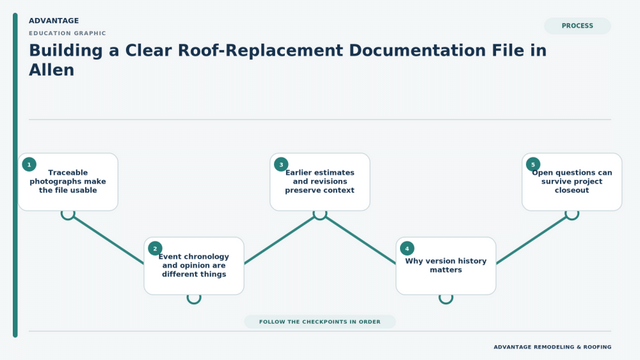
Traceable photographs make the file usable
A photograph is much more useful when it has a date and a location. Record enough context to identify the roof plane, transition, attic area, room, exterior edge, or other place shown. When practical, keep a wider context image along with a closer view.
If a written finding refers to the photo, the location language should match. That makes later comparison easier and helps prevent a close-up image from being treated as if it shows the entire system.
Photographs document visible conditions. They do not establish concealed extent or a hidden cause on their own.
Keep measurements beside the finding they support.
Measurements and scale give photographs and descriptions useful physical context. Preserve the basis of the measurement instead of copying a number into a later document with no explanation of where it came from.
This is especially important when a quantity may change because access is limited or conditions are concealed. A current figure can be a legitimate planning value without being a promise that the final quantity will be identical.
When the measurement basis is visible, later readers can understand whether a revision reflects a new measurement, a newly accessible condition, or a clarified assumption.
Event chronology and opinion are different things
Chronology is important, but sequence is not the same as causation. A useful file distinguishes dates and observations from interpretations and decisions.
For example, keep the date a condition was observed separate from a contractor’s recommendation about what to do. Keep any policy or payment interpretation separate from the contractor’s property finding. If a homeowner, contractor, or another participant makes a decision, record the decision as a decision rather than rewriting it as if the underlying fact had been proven by the decision itself.
This separation makes the file easier to reconstruct and reduces the chance that later readers will mistake an opinion for an observation.
Earlier estimates and revisions preserve context
Do not replace the history with only the newest estimate. Earlier versions can show how the proposed work changed over time.
When a revision occurs, attach a short reason: a new observation, a corrected measurement, a concealed discovery, a clarified assumption, or another documented basis. The revision then becomes understandable without implying that the new document proves coverage, approval, payment, cause, or final scope.
If a supplement or additional request exists, preserve it as part of the history. Its presence does not by itself show that another party accepted it.
Make scope changes explain themselves.
A homeowner should be able to follow the connection between new evidence and a changed proposal. If a line item appears, changes quantity, or is removed, keep enough context to understand why.
This is also a useful way to catch gaps. If a major change has no documented reason, ask for clarification while the project history is still fresh.
Clear revision records protect everyone from having to reconstruct the reason later from memory.
Why version history matters
More pages do not automatically make a roof file clearer. A smaller set of well-labeled documents can be more useful than a large folder in which the newest estimate silently replaces the older one and photographs have no location.
Version history gives the file a backbone. When an estimate or scope changes, preserve the earlier version and add the reason for the revision. When a measurement is corrected, note the new basis. When access reveals a condition that was previously unknown, identify the location and the date it became observable.
This makes the file useful to someone who was not present for every conversation. That reader can distinguish the first observation from the later interpretation and the original scope from the revised one. It also prevents a later approval, payment discussion, or warranty question from being confused with the underlying property evidence.
The objective is traceability: a homeowner should be able to move from a document back to the event or observation that explains why it exists. A useful file also makes unanswered questions easy to find. Keep a short open-items note for conditions that still need access, measurement, product confirmation, or another decision. When an item is resolved, add the date and the evidence that resolved it instead of deleting it from the history. This keeps the file from giving a false impression that every question was settled from the beginning. It also helps the homeowner see which later scope changes came from genuinely new information rather than from a rewritten version of the earlier record.
Open questions can survive project closeout
A closeout file can include final photographs, completed-work documents, the final scope and revisions, product or other relevant records, and any unresolved items that still need follow-up.
The file should preserve what happened, not promise what will happen later. It cannot guarantee a future warranty response, coverage decision, payment, or dispute outcome.
If follow-up is expected, state the reason and the condition that would prompt it. That keeps the file useful after the immediate project ends.
A well-built documentation file is valuable because it explains decisions. It lets a homeowner distinguish observation from interpretation, current scope from prior versions, and documented facts from unresolved questions. When the record is tied to dates, locations, measurements, and reasons for change, later decisions can be checked without turning the paperwork itself into proof of something it was never capable of establishing.