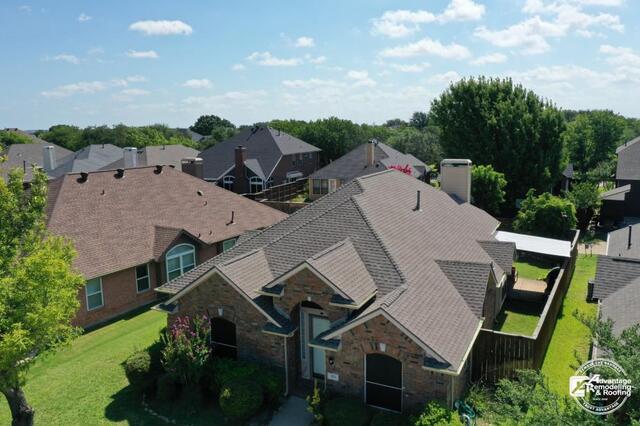
Roof concerns rarely arrive as a neat story. Weather may occur on one date, a homeowner may notice a symptom later, temporary work may change the condition, and a later inspection may reveal something that was not visible before. The temptation is to connect those events into a single explanation. A better chronology keeps the order accurate while leaving cause open until the property evidence supports it.
For an Allen homeowner, that means reconstructing the sequence one verified event at a time.
If the sequence now crosses several distinct weather periods, place it beside the complications that build across multiple Allen storm seasons. That comparison can show which observations belong to the same roof location and which questions became more difficult only as later seasons added new information.
The chronology comes before the explanation
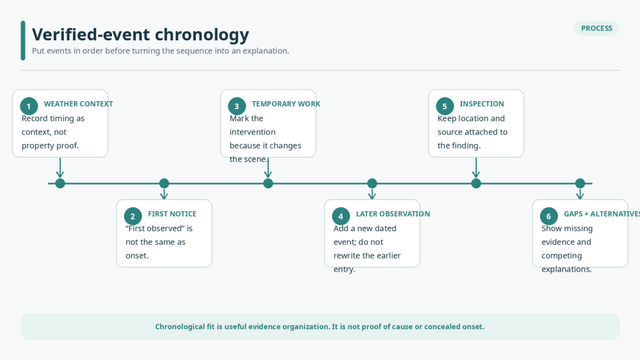
Start with the simplest entries: date or date range, location, what was observed, and where the information came from. Weather context can be included, but it should be labeled as context. A photograph, homeowner observation, contractor visit, temporary action, and later discovery are different kinds of events.
This first pass should read almost like a log. Its job is to preserve what is known before interpretation changes the language.
When a date is uncertain, keep it uncertain. A range is more accurate than inventing a specific day because it makes the timeline look cleaner.
First notice is not necessarily the beginning
The date a homeowner first saw a stain, drip, lifted material, or other symptom is a verified observation date. It is not automatically the date the underlying condition began.
That distinction matters. Backdating a condition from first notice can silently create a causal story that the evidence does not support. The same problem occurs when the first notice is automatically linked to an earlier weather event.
Use wording that preserves the boundary: “first observed on” is different from “began on.” If concealed onset cannot be established, leave it unknown.
Three different dates, three different meanings
In many roof histories, the weather date, the first-observed date, and the intervention date are different. Keep them different. If a later inspection adds a new finding, that becomes another date rather than a reason to rewrite the earlier entries.
This protects the chronology from accidental backdating. A condition discovered during later access may have existed earlier, but the later discovery date is the point that can be verified unless separate evidence establishes more. The same rule keeps a homeowner’s first notice from becoming an invented onset date.
Temporary work changes the scene
Tarping, sealing, drying, or another temporary action can alter what is visible later. Record the intervention as its own event: when it occurred, what area it addressed, and what visible effect followed.
A quieter symptom after stabilization can be important. It still does not prove the original cause, concealed pathway, or final repair scope. It shows that conditions changed after an intervention.
Later inspections should account for that changed scene. A dry area after temporary work is not the same observation as the same area before the work.
Weather direction matters only when the property comparison is real
Weather direction and timing may help frame inspection questions when they can be compared with roof geometry and actual property locations. The comparison should remain grounded in the house.
Directional alignment is not proof of a leak route. A weather source does not prove that a particular property was damaged. If the property observations do not support the directional theory, the chronology should show that conflict rather than force the events to fit.
Competing explanations and missing evidence belong together
A good timeline can support more than one possible explanation. It can also reveal that an important date, photograph, access point, or earlier-work record is missing.
Do not hide those gaps. Write them next to the events they affect. For example, a later finding may fit the timing of an earlier symptom but still lack evidence showing when the concealed condition began. A recurrence may fit one explanation while another property observation does not.
Preserving those tensions is a strength. It prevents chronological fit from being mistaken for causal proof.
What missing evidence can still tell you
A missing date, unlabeled photograph, or unavailable earlier-work record should not be treated as useless. The gap tells the next inspector what the chronology cannot answer. If the missing item affects a same-location comparison or the interpretation of a temporary intervention, the inspection can focus on evidence that may reduce that uncertainty.
A chronology is therefore not only a history. It is a map of where the history is strong and where the next property observation matters most. The source of each timeline entry matters too. A homeowner recollection, a dated photograph, a service record, and a later inspection finding do not carry the same kind of information. Keep the source attached to the entry so a later reader can tell what was directly documented and what remains approximate. That is especially important when the chronology spans temporary work or delayed discovery, because later knowledge can otherwise creep backward into earlier dates. A transparent source note prevents the final story from becoming more certain than the evidence that produced it. The final timeline should remain useful even if the next inspection changes the working explanation. That is a sign the chronology preserved evidence rather than a predetermined story.
Where the sequence points the next inspection
Once the verified events are in order, ask what the chronology makes worth checking next. Which location has the strongest same-place recurrence? Which temporary action changed the evidence? Which access gap prevents a meaningful comparison? Which date or earlier-work record would clarify the story if it can be found?
The next inspection can then focus on those questions rather than repeating a general roof review with no connection to the history.
A reconstructed sequence is most useful when it does not pretend to know more than the record shows. By separating weather timing, first notice, interventions, locations, later discoveries, and missing information, a homeowner gets a timeline that can guide the next step without turning the order of events into proof of cause.