Repair and replacement should not be compared as opposing philosophies. They are two possible responses to the same property evidence. For an Allen homeowner, the useful question is whether the verified condition is truly local and repairable within the surrounding system, or whether the pattern and practical consequences justify a broader replacement review.
Before comparing the two scopes, place the observations on a date-by-date roof concern timeline. Seeing when each finding, temporary action, and later change entered the record can show whether the decision is still about one isolated condition or a pattern that deserves broader review.
That comparison works best when both options are tested against the same locations, access limits, material conditions, prior work, and unresolved questions.
Is the condition actually local?
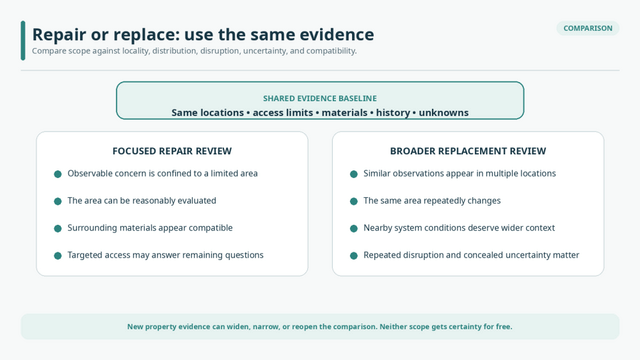
A focused repair deserves serious consideration when the observable concern is confined to a limited area, that area can be reasonably evaluated, and the surrounding materials appear compatible with the proposed work. None of those points should be assumed from location alone.
If the relevant area cannot be accessed, if the material match is uncertain, or if nearby conditions have not been evaluated, repairability remains an open question. A small visible symptom can still require a careful inspection before anyone knows whether a narrow repair is practical.
The goal is not to disqualify repair. It is to make sure “local” describes the evidence rather than simply the size of the mark a homeowner can see.
Evidence beyond a single spot
A broader review becomes more relevant when similar observations appear in multiple locations, when the same area repeatedly changes, or when nearby system conditions suggest that the concern should not be evaluated in isolation.
Distribution matters because it changes the question. Instead of asking only how to address one visible point, the homeowner may need to ask whether several observations share material, transition, moisture, airflow, or adjacent-component context that affects the usefulness of a focused repair.
Multiple observations do not automatically mean replacement. They also do not prove a single cause. They are a reason to test whether the original “one isolated spot” assumption still fits.
Put roof age and earlier work in their proper place.
Age and repair history can help explain the decision, but neither is a replacement rule. An older roof may still have a localized condition that is worth evaluating for repair. A roof with earlier repairs is not automatically beyond repair. Conversely, a relatively recent roof can still have a condition that deserves broader review.
Use history to ask better questions. Is the current concern near documented earlier work? Can the present location actually be matched to that history? Do surrounding materials appear compatible with another repair? Has the same area been repeatedly disrupted?
What age cannot establish by itself is remaining life, repairability, warranty response, or a required replacement outcome.
Disruption belongs beside today's price
A repair can have a lower immediate price and still carry practical costs if the same area is likely to require repeated access. A replacement can involve more work now and still be difficult to justify if the property evidence remains narrow and localized.
When comparing options, include the consequences of future access, repeated work, possible interior exposure, and uncertainty about concealed conditions. These are not predictions that a problem will occur. They are decision factors that help a homeowner compare the effect of each option if new evidence appears later.
Ask what happens if the repair area cannot be completed as assumed. Ask what the replacement scope does—and does not—resolve. A broader scope should not be treated as a way to erase uncertainty that still exists.
Attic and adjacent-system evidence can challenge a surface-only view
When relevant observations are available, compare the roof concern with accessible attic, moisture, airflow, or adjacent-component conditions. These can show whether the visible symptom is best treated as a surface-only question or whether the surrounding assembly deserves a wider look.
The relationship must remain evidence-based. An attic observation does not prove the roof entry point. A surface condition does not prove concealed moisture. System context is there to test the repair assumption, not to create a hidden cause by inference.
Compatibility can change a repair decision
A repair recommendation is stronger when it can explain not only the visible defect but also how the proposed work will meet the surrounding materials and components. If compatibility is assumed because the materials “look similar,” the homeowner still has an unresolved question.
The same discipline applies to access. A repair may appear straightforward from the visible surface while a connected area remains concealed or unreachable. That does not make repair impossible, but it means the decision should identify what is known and what would need to be verified before the repair assumption can be treated as settled.
Replacement should face an equivalent test. A broader scope should explain which compatibility or system questions it resolves and which remain outside the work. This keeps the comparison centered on supported property conditions instead of letting the word “replacement” imply complete certainty. If the evidence supports repair today, the decision can still include a contingency for new access or incompatible materials. If the evidence supports broader replacement review, the homeowner can still ask which parts of the roof are driving that broader view. In both cases, the decision becomes easier to defend because it states what would have to be different for the other option to become more reasonable. That is a more useful comparison than treating repair as “temporary” or replacement as “complete” without examining the actual limits of each scope.
The reason one option fits better
A useful decision record should state why repair or replacement was selected based on the evidence available today. It should also state the limits of that decision.
For a repair, note what makes the condition sufficiently localized and what finding would pause or reopen the plan. For a broader replacement review, note which distributed, repeated, material, or practical factors made a narrow approach less convincing.
This makes the decision reversible when the evidence changes. A concealed discovery, a new same-location recurrence, an access limitation that is later resolved, or new compatibility information may change the comparison.
Repair and replacement become easier to evaluate when neither option is allowed to borrow certainty from the other. Use the same property evidence, keep the unknowns visible, and choose the scope that best matches what is actually supported now.