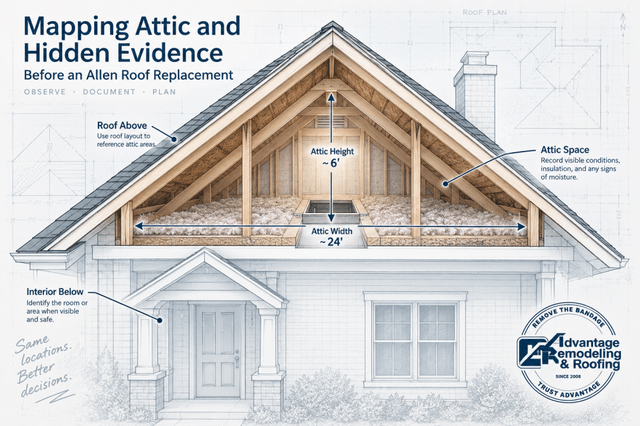
The attic can help connect a roof-replacement discussion to what is happening inside the building, but attic observations need careful limits. A stain, moisture reading, airflow condition, insulation pattern, or visible section of decking can be useful evidence without proving the source, duration, concealed extent, or final repair scope.
For an Allen homeowner, the best way to use attic evidence is to map it to real locations, compare it over time, and keep inaccessible areas honestly unresolved.
An attic observation needs a repeatable location
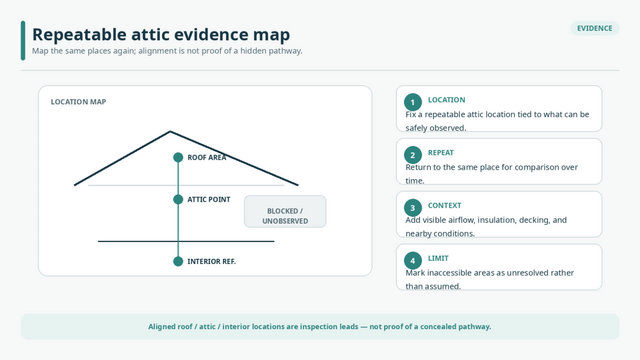
A note such as “moisture in attic” is difficult to compare later. A location-based record is more useful. Identify the attic area in relation to the roof above and the room or interior area below when that relationship can be observed safely.
The purpose is not to claim a hidden pathway because two locations appear aligned. It is to create a shared map so a later inspection can return to the same places and compare the evidence consistently.
Photographs can support the map, particularly when the viewpoint is clear. They still show only what was visible from that access point.
Repeated observations can matter more than one reading
A single attic observation is a snapshot. If the same location can be reviewed again, the pattern may become more useful. Has an area remained dry? Has visible wetting returned? Has a mark spread? Did a condition change after a period when it appeared stable?
Those changes can justify another review, but they do not establish cause by themselves. Timing can help organize the evidence without proving where moisture originated or how long it was present.
A dry interval also deserves the same caution. It may show that the condition was not continuously visible, but it does not prove that every concealed question has been resolved.
Moisture observations need assembly context
Attic evidence should not be reduced to moisture alone. Airflow, insulation, visible decking, and nearby conditions can affect how heat and drying are understood. These observations can help the homeowner see why more than one explanation may need to remain open.
For example, an attic condition may deserve comparison with exterior observations, but the comparison should not jump directly to an exterior entry conclusion. Likewise, visible insulation or airflow conditions do not establish that a particular design is adequate or inadequate on their own.
The goal is to build context around the observation, not to turn every visible condition into a diagnosis.
Inaccessible areas are still part of the scope question
Some important conditions may not be visible before work. If a relevant section cannot be inspected, carry that limitation forward instead of assuming what will be found.
A replacement scope can describe the work that is supported now and also explain how newly exposed conditions will be documented and reviewed. That is different from pricing or approving a concealed condition before it is seen.
Homeowners should know what would happen if later access reveals something material: how it will be photographed or otherwise documented, who will explain the effect on the work, and when a decision will be needed.
Planning for conditions that are not yet visible
A homeowner does not need to know the concealed condition in advance to plan how it will be handled. The scope conversation can identify which areas remain inaccessible, what kind of documentation will be made if they are exposed, and when the new finding would be reviewed before additional work is treated as settled.
This is particularly useful when an attic map shows that an important comparison is incomplete. The map can identify the location and the access limit without drawing a pathway through materials that have not been observed. If later work exposes that area, the new evidence can be added to the same location record and compared with the earlier attic, roof, and interior observations.
That continuity makes a concealed discovery easier to interpret because the homeowner can see what was known before access changed and what was learned afterward.
What a useful attic record preserves
Keep enough context to revisit the same place: date, location, visible condition, relevant reading if one was taken, and the access boundary. If airflow, insulation, or visible decking is part of the comparison, note what was actually observed rather than a conclusion about the entire assembly. The attic record can also help a homeowner decide whether a later observation is truly new. If an area was visible and dry on one date, that becomes a useful comparison point. If an area was never accessible, the later discovery should not be described as a change from the earlier condition; it is new information from new access. That distinction protects the timeline from implying a hidden condition was known before it was actually observed.
A map is not a cause diagram
A location map is valuable because it helps compare roof, attic, and interior observations. Its strength is also its risk: once several points appear to line up, it can be tempting to draw an unseen pathway between them.
Keep the wording disciplined. “These observations are near the same location” is different from “this is the route moisture traveled.” The first describes what the evidence supports. The second may require concealed information that is not available.
That distinction protects the homeowner from building a scope around an explanation that has not yet been verified.
What should reopen an attic review?
Before closing the file, identify the kind of change that would make another attic review worthwhile. A same-location recurrence, new spread, a new safely observable condition, or a concealed discovery during work can all change the evidence available to the homeowner.
Preserve the location map and the dated observations so the next review does not start from memory. If new access becomes available, compare what is found with the earlier limits and observations rather than treating the new information as if it had always been known.
Attic evidence is most helpful when it gives the roof decision better context while keeping uncertainty visible. It can strengthen the questions that shape a replacement scope without pretending to prove a hidden cause, concealed extent, or structural condition that has not actually been observed.