A contractor interview is easier to evaluate when the conversation begins with evidence rather than confidence. Price matters, and so does communication, but neither tells you what was actually inspected or why a proposed roof-replacement scope fits the property. For an Allen homeowner, a useful interview should make the contractor’s inspection, assumptions, exclusions, and change process understandable enough that you can compare them with another proposal on the same terms.
Inspection evidence comes before a sales conclusion
Ask the contractor to explain what areas were inspected, how the locations were identified, and what could not be observed. The answer should distinguish visible findings from inaccessible or concealed areas.
Photos can help, especially when they are labeled well enough to return to the same location. But a photograph does not establish what lies behind the visible surface. If a proposal uses broad language about an area that was not accessible, ask what part of that language is based on direct observation and what part remains an assumption.
A strong inspection explanation should be repeatable. Another visit should be able to identify the same roof plane, transition, attic area, or interior location and understand why it mattered.
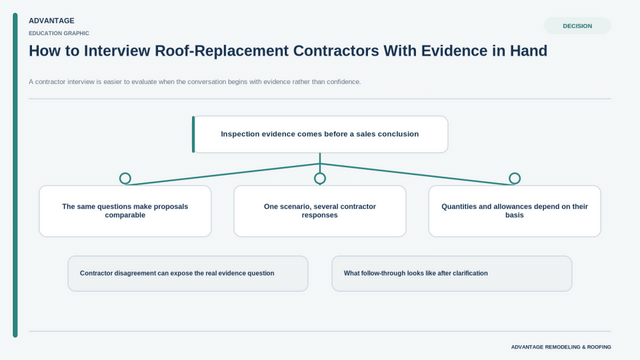
The same questions make proposals comparable
Two roof proposals can look very different even when they are responding to the same property. Before comparing the totals, line up the work categories. What components are included? What assumptions were used? Which quantities are measured, estimated, or subject to field verification? What is excluded? What happens if a concealed condition changes the work?
This is where a lower or higher total becomes more meaningful. A price difference may reflect different work, different quantities, or different assumptions. Without aligning those items, the totals alone do not tell you which contractor understood the property better.
Ask each contractor to explain the connection between a finding and the proposed work. The goal is not to force identical scopes. The goal is to understand why the scopes differ.
One scenario, several contractor responses
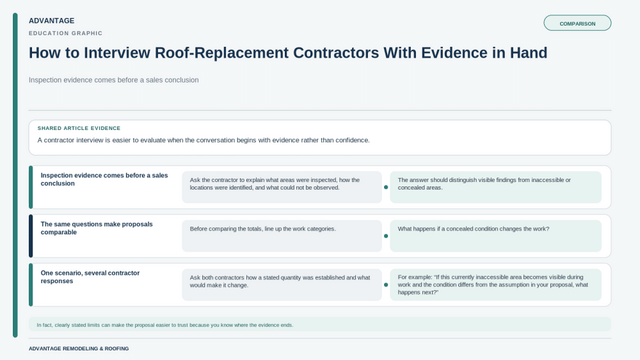
One practical comparison is to give each contractor the same unresolved scenario. For example: “If this currently inaccessible area becomes visible during work and the condition differs from the assumption in your proposal, what happens next?” The useful part of the answer is not confidence. It is whether the contractor can explain the documentation, decision point, scope-change process, and any product questions without pretending to know what will be found.
The same technique works for quantities and exclusions. Ask both contractors how a stated quantity was established and what would make it change. Ask both what is outside the proposed work. Consistent questions make differences easier to evaluate because each proposal is being tested against the same uncertainty rather than against a different sales conversation. Before choosing among contractors, read the written proposals without the sales conversation in mind. See whether the documents still explain the inspection basis, open assumptions, exclusions, and change process on their own. If an important claim only makes sense because of something said verbally, ask for the relevant clarification in writing. That does not make the document more “official”; it simply makes the comparison traceable and reduces the chance that two people remember the same conversation differently.
Quantities and allowances depend on their basis
A written quantity can look exact even when the underlying condition could not be fully measured before work begins. Ask which figures come from direct measurement and which depend on access or concealed conditions.
Allowances should be understood the same way. They can be useful planning tools, but they are not proof of what will be found. A contractor should be able to explain what the allowance covers, what would trigger a change, and how the change would be documented.
That keeps a planning number from being mistaken for a verified concealed condition.
Discuss hidden discoveries before tear-off.
One of the best times to discuss concealed conditions is before they are visible. Ask what happens if work exposes something that was not reasonably observable during the inspection.
A clear process should address documentation, communication, pauses when a decision is needed, and how additional work would be approved. Product or manufacturer requirements may also become relevant depending on what is actually proposed or discovered. Those questions should be identified without promising a warranty result or assuming a concealed condition exists.
The point is not to predict every surprise. It is to know how the contractor will handle new evidence without turning the project into an undocumented sequence of verbal changes.
Contractor disagreement can expose the real evidence question
If two contractors disagree materially, do not automatically choose the one who sounds more certain. Identify the exact disagreement. Are they describing different observed conditions? Did one inspect an area the other did not? Are they using different assumptions about a component or quantity? Is one proposal silent on an item the other treats as important?
Sometimes the disagreement can be resolved by reviewing the documents. Other times a focused return inspection may be useful. The important thing is to turn the conflict into a specific evidence question rather than a contest of confidence.
What follow-through looks like after clarification
Follow-through is part of the comparison. When you ask a reasonable question, does the contractor answer it directly? If a document needs correction or clarification, is the revision visible? Are unresolved items acknowledged, or do they disappear behind general language?
A dependable proposal should become clearer as questions are answered. The contractor does not need to claim certainty about inaccessible conditions. In fact, clearly stated limits can make the proposal easier to trust because you know where the evidence ends.
By the end of the interview, you should be able to explain the proposed work in your own words: what was observed, what remains unknown, what is included, what is excluded, how quantities were established, and how later discoveries would be handled. That is a much stronger basis for comparing contractors than confidence, urgency, or total price by itself.