Weather history can help an Allen homeowner put roof observations in order. It can show when a symptom was first noticed, when it returned, whether a quiet period followed, and which property locations deserve comparison. What it cannot do by itself is prove why a condition exists on one particular roof.
The strongest use of weather history is therefore organizational: build a chronology around the home’s observations, then use that chronology to decide what should be inspected or compared next.
Build the timeline from the property outward.
Start with what was actually observed at the property. Record the date, location, and nature of the condition. Then add relevant weather periods as context around those observations.
That order matters. If the timeline begins with a regional event and then searches for a matching roof explanation, it is easy to mistake proximity in time for proof of cause. Starting with property observations keeps the review centered on evidence you can locate and revisit.
If exact weather details are not available, do not invent a property-specific storm history. A general recollection that “there was bad weather around then” may help frame a question, but it is not the same as verified property evidence.
When the homeowner has only a broad weather recollection, roof-replacement decisions can become harder across multiple storm seasons. Bringing the dated property observations that do exist into a contractor interview built around the evidence in hand helps keep recollection and roof findings from being blended together.
Recurrence begins with location
When a symptom repeats, ask whether it is truly the same place. Labeled photos, simple measurements, and room or roof-location references can help distinguish a same-location recurrence from a nearby but different condition.
That distinction can change the next inspection question. Repetition at the same location may justify closer review of that area and any related components. But it still does not establish the concealed pathway, structural condition, or cause.
A timeline becomes much more useful when “it happened again” can be translated into “this exact area showed a similar change on these dates.”
Quiet periods are part of the chronology
A dry or symptom-free interval is information. It may help compare conditions under different circumstances, and it may show that an earlier symptom did not remain continuously visible.
A quiet interval is not automatic closure. It does not prove that a concealed condition is absent or that the earlier question was resolved. Instead, it gives you another comparison point. If the same symptom later returns, the quiet period can help define the pattern more clearly.
This is especially useful when homeowners are deciding whether a concern is stable enough to monitor or whether recurrence warrants another inspection.
History can test an assumption without deciding it
Prior work, distributed wear, and repeated observations can test whether an isolated-repair assumption still fits the property. If a condition has recurred near documented earlier work, that history is relevant. If similar observations appear in several locations, that distribution may also affect how narrowly the concern should be viewed.
Neither situation proves that an earlier repair failed, that cumulative weather exposure caused the present condition, or that replacement is required. The history is there to challenge or support the working explanation—not to replace inspection.
This distinction matters because a long record can feel persuasive even when key facts remain missing. More dates do not automatically equal more certainty about cause.
Keep cumulative exposure separate from a confirmed cause.
A roof exists through many weather periods. Over time, the history may show repeated opportunities for environmental exposure, changing symptoms, or long intervals with no visible issue. That context can be important when deciding what to inspect.
Still, cumulative exposure is not a property-specific cause finding. To move from timing context to a causal conclusion, the property evidence must do the work. Concealed conditions, entry paths, and structural questions cannot be settled by chronology alone.
When those facts are not available, say so plainly in the working record.
Contradictions belong in the chronology
A useful weather history does not need every entry to point in the same direction. If a symptom recurs after one weather period but not another, keep both facts. If a location appears consistent with one explanation while an attic or interior observation does not, preserve the conflict rather than smoothing it away.
Contradictions can be some of the best guides for the next inspection because they show where the current explanation is incomplete. They also protect the homeowner from letting a long list of dates create false confidence. A chronology becomes stronger when it records what does not fit as carefully as what does.
That is especially important when earlier work appears in the history. A repair date can be included without assuming the repair failed, and a recurrence can be documented without assigning the same cause to both episodes. A homeowner can also use the timeline to prepare a more efficient inspection conversation. Bring the chronology in a form that shows the property location beside each dated observation. Mark entries that depend on memory, entries supported by photographs, and entries affected by earlier work or limited access. That makes it easier to see which parts of the history are well supported and which still depend on verification.
If a later observation seems to strengthen an earlier theory, check whether the theory also explains the quiet intervals and the locations that did not change. A weather-based explanation should not be accepted merely because it fits one date. The chronology is strongest when it can challenge the preferred explanation as well as support it.
What the timeline still cannot answer
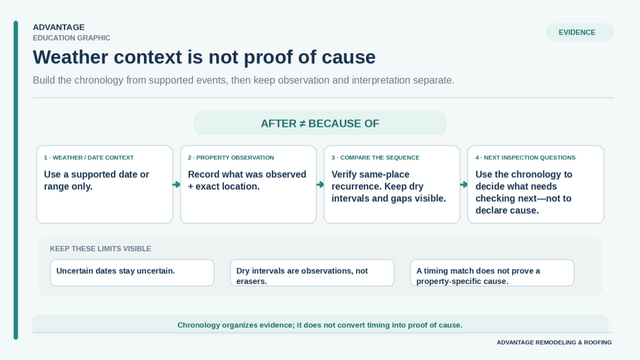
A useful history does not need to end with a verdict. It can end with a better inspection plan.
List the dates that remain uncertain, the locations that have not been confirmed, any relevant earlier work that lacks documentation, and any areas that could not be accessed. Note which same-location observation would be most useful to compare next.
That turns weather history into practical decision support. Instead of saying, “This happened after weather, so weather caused it,” the homeowner can say, “These property observations changed around these dates, this location recurred, these areas remain unknown, and these are the questions the next review should answer.”
That is a more disciplined way to use timing: as context that sharpens the property-level investigation without pretending the calendar can diagnose the roof.