A roof concern that becomes quiet can feel resolved. Dry weather, temporary work, or another change may reduce a visible symptom enough that the issue disappears from daily attention. If the symptom later returns, the quiet interval becomes valuable evidence—but not proof that the underlying condition was permanently fixed and then failed again.
For an Allen homeowner, the better question is what changed during the quiet period and whether the returning symptom can be matched to the same location.
Describe what the temporary action actually changed.
If temporary work was performed, record the visible purpose and result without assigning it more meaning than the evidence supports. A tarp, temporary seal, drying effort, or other stabilization may reduce exposure or symptoms. That does not establish the original cause or final scope.
Write down the location, date, and observable effect. If an interior area dried, note that. If active symptoms stopped for a period, note that too. The record should distinguish “symptom reduced after this action” from “underlying pathway permanently resolved.”
That difference becomes important if the condition returns.
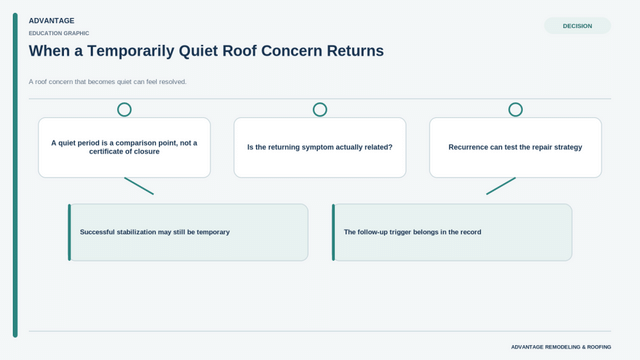
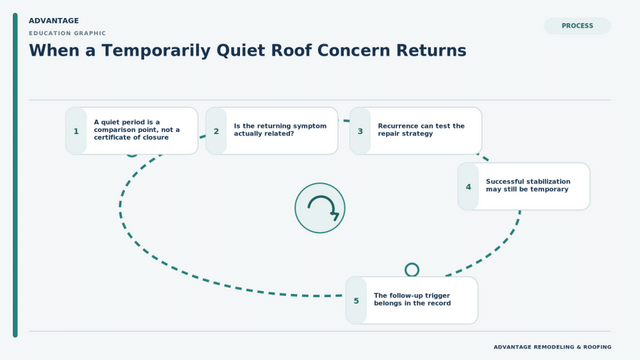
A quiet period is a comparison point, not a certificate of closure
Symptom absence can help show how the area behaved under different conditions. It may also provide a cleaner baseline for later comparison.
But dryness is not proof of permanent repair, concealed-condition resolution, or verified material compatibility. Favorable weather may simply mean the area was not tested by the same exposure that made the symptom visible before.
Keep the quiet interval in the history. Do not erase the earlier concern because the property was temporarily calm.
Is the returning symptom actually related?
When the concern returns, match the location carefully. Is it the same interior point, attic area, roof plane, transition, or other inspection location? Or is it nearby but different?
A same-location recurrence can make the earlier question more important. A different location may represent another condition that should not be merged into the old story.
Even a confirmed same-location recurrence does not prove one causal event or a concealed pathway. It does show that the earlier symptom-control period did not provide enough information to close the question permanently.
Recurrence can test the repair strategy
Repeated temporary work can become part of the repair-versus-broader-review decision. Ask whether the same area has required repeated access, whether surrounding material conditions have changed, and whether a focused repair remains reasonably feasible based on what can actually be inspected.
This is not a rule that recurrence means replacement. It is a reason to revisit the durability and practicality of the current approach.
A temporary measure can still be valuable even when it is not permanent. Protecting the home and creating a quieter condition for observation may be exactly what is needed while the evidence is being developed.
Keep weather dependence in the right role.
If symptoms appear during one weather period and disappear during another, that pattern is worth recording. It may help decide when another inspection would be most informative.
The timing does not establish storm causation, coverage, warranty response, required replacement, price, schedule, or outcome. It simply describes when the property showed the symptom.
The property-level observations still have to support any stronger conclusion.
Successful stabilization may still be temporary
Temporary work can accomplish an important purpose even when it does not establish a permanent repair. If the home is protected, active symptoms reduce, or the area becomes stable enough to observe, the intervention may be doing exactly what was intended.
Problems arise when the visible success of stabilization is rewritten as proof that the hidden cause was found or permanently resolved. Keeping the purpose narrow makes later recurrence easier to interpret. The homeowner can ask whether the symptom returned at the same location, under what conditions, and what the temporary action had actually changed.
That history may support a more focused permanent repair, or it may show that repeated temporary actions are no longer an efficient strategy. The choice still depends on current material condition, access, and the broader pattern rather than on the number of temporary visits alone.
A quiet period is therefore useful twice: first because it may protect the property, and second because it creates a comparison condition for the next observation. When the concern returns, compare the new observation with the conditions during the quiet interval as well as with the original symptom. That three-point comparison can show whether the area is repeating the same pattern or whether something materially different is happening. If the temporary action was still in place, note that. If it had been removed or changed, note that too. The purpose is to understand the conditions under which the symptom reappeared, not to assign a cause from timing alone.
This record can also help decide whether the next step should be a focused check or a broader review. The answer depends on the location match, material condition, access, and whether recurrence is isolated or part of a wider pattern.
The follow-up trigger belongs in the record
A recurring concern is easier to manage when the next review is tied to a specific condition. Define what should prompt another check: recurrence at the same place, a change in size or spread, a new related observation, or another threshold that makes the existing repair assumption worth reconsidering.
Also identify who is expected to respond to that trigger. A follow-up plan is more useful when someone knows what evidence to preserve and what location to revisit.
The quiet period should therefore become part of the evidence, not the end of the evidence. By separating temporary symptom control from permanent resolution and matching recurrence carefully, an Allen homeowner can decide when the roof question should be reopened without treating every return as proof of a single cause or automatic replacement need.
Put that trigger and the person responsible for it into a clear written roof-replacement communication record. If the concern returns, the homeowner can see the earlier assumption, the exact location to revisit, what new evidence was preserved, and why the decision is being reconsidered.