A small roof concern does not become important merely because a certain number of days have passed. It becomes more meaningful when the evidence changes. For an Allen homeowner, that can mean a symptom returns at the same location, becomes larger, affects function, appears in another related area, or stops fitting the assumptions that made simple monitoring reasonable in the first place.
If that change triggers a second look, bringing the dated observations into an evidence-based roof-contractor interview makes it easier to compare how each contractor approaches the same location and open questions.
The useful question is therefore not “How long should I wait?” but “What would have to change before another inspection makes sense?”
A useful baseline starts with place and date
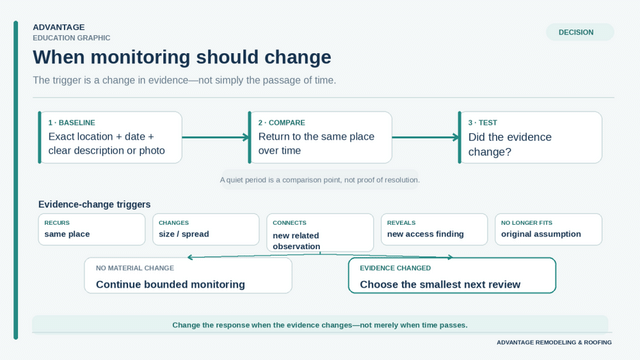
When a condition is minor, create a simple baseline while it is still easy to describe. Note the date and exact location. Keep photographs or written observations clear enough that you can return to the same place later. If the concern is visible from more than one safe area—such as an interior location and an accessible attic area—keep those observations separate but location-linked.
A baseline is not proof of cause. It is simply the reference point that makes later change easier to recognize. Without it, homeowners often end up comparing a current condition with a vague memory of what it “used to look like.”
What ends simple monitoring?
Monitoring works best when it has an exit condition. Before you put the issue aside, identify the kind of change that would justify another look.
For one concern, that may be recurrence after a quiet period. For another, it may be visible spread, a change in drainage behavior, a new observation at a nearby location, or an indication that the condition is affecting how a part of the system functions. The important point is that the trigger is tied to evidence, not anxiety or sales pressure.
Crossing that threshold does not automatically dictate repair or replacement. It means the original “watch it for now” assumption should be reconsidered.
A practical monitoring threshold
A useful threshold is something a homeowner can recognize later. It might be a same-location recurrence after the area had been quiet, a visible change in size, a new nearby observation, or a change in how drainage or another roof function behaves. The threshold should be chosen because it would make the original monitoring assumption less reliable.
That is different from creating an alarm rule. A threshold does not predict what the next inspection will find. It simply prevents indefinite monitoring after the evidence has materially changed. When the trigger occurs, the next step can still be proportionate: a focused inspection may be enough, or the new pattern may justify a broader scope discussion.
Writing the threshold down also reduces hindsight bias. Later, the homeowner can see why the concern was reopened and whether the response matched the change that was actually observed.
Same-place comparisons are stronger than a repeated story
If a symptom returns, compare the exact location with the earlier record. A same-place recurrence deserves more attention than a general statement that “the roof is acting up again,” but recurrence still does not establish a hidden entry path or cause by itself.
Where safe and available, compare exterior, attic, and interior observations that relate to the same area. The purpose is to test whether the original explanation still fits the evidence. A location relationship may strengthen the reason for a focused inspection, yet concealed conditions remain unknown until they are actually observed.
This is also where access limits should stay visible. If a relevant area cannot be inspected, that gap should remain a gap rather than becoming an assumed fact.
Weather and earlier work are context, not conclusions
Weather timing and repair history can help organize a roof concern, but neither one should be allowed to do more work than the property evidence supports.
A symptom that appears after a weather period may be worth documenting in the chronology. An earlier repair in the same general area may also be relevant. Neither fact, by itself, proves the present cause, damage mechanism, concealed condition, or required scope.
Use these details to form better questions: Did the same location change? Was the condition present before? Is there documented earlier work that should be compared with today’s observation? Are there parts of the assembly that have not been inspected?
That keeps history useful without turning timing into a shortcut.
The response can grow with the evidence
A small concern can lead to several reasonable next steps. Continued monitoring may still make sense when the condition is stable and the original assumptions remain consistent with what you can observe. A focused inspection may be appropriate when one location changes or returns. A broader scope review may be warranted when the evidence no longer looks isolated or when unresolved questions affect the decision between narrower and broader work.
The homeowner should be able to explain why the response changed. “It looked worse” is less useful than “the same location changed between these dated observations, and the earlier monitoring assumption no longer fits.”
Why the reason for the decision matters
When the plan changes, preserve the reason. Keep the dated baseline, later observations, access limitations, and any documented revisions together. That record can prevent the next discussion from starting over from memory.
It also protects against a common mistake: treating the latest opinion as if it erases the earlier uncertainty. A new inspection may resolve some questions and create others. The goal is not to force certainty where it does not exist. The goal is to make the next decision traceable to what actually changed.
A minor roof concern merits another look when new evidence gives you a reason to revisit it—not simply because time passed, a storm was mentioned, or someone proposed a larger scope.