Roof Replacement in Richardson, TX
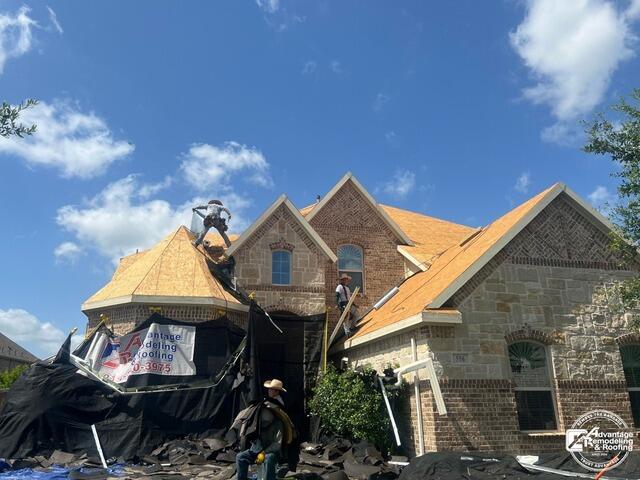
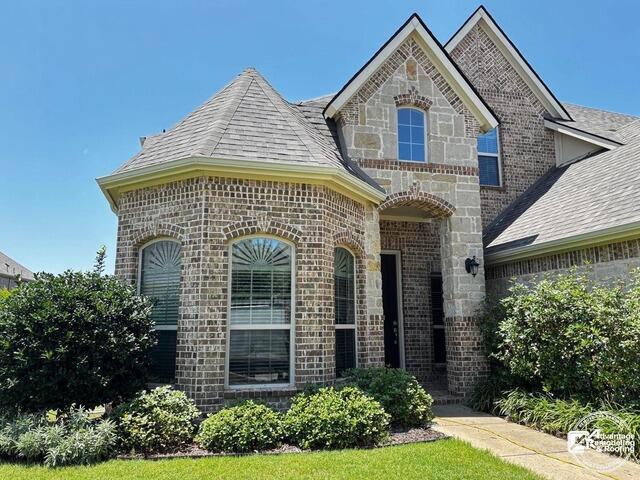
This Richardson roof replacement is easy to understand because the two project photographs show opposite ends of the work: an active replacement stage and the finished roof across the same highly detailed front elevation. The home has several intersecting roof sections, multiple front-facing gables, a rounded roof area over the left side of the façade, and changes in height around the central entry. Those architectural features make the roof a major visual part of the house rather than a single flat background above the brick and stone exterior.
In the Before image, much of the existing roof surface has already been removed. Large areas of exposed wood are visible across the roof planes, and crew members can be seen working at different points on the structure. Roofing debris is visible near the ground, while dark protective coverings are positioned across part of the front of the property. The photograph captures the house in the middle of a substantial exterior project, when the finished roofing surface is temporarily absent and the underlying shape of the roof is unusually easy to see.
That mid-project view is useful for homeowners because it reveals how much geometry can be hidden by a finished roof. The rounded section at the left has to meet adjacent slopes cleanly, while the front gables rise above lower roof areas and create several visible transitions. The image does not establish why the roof was replaced or what hidden conditions may have existed, but it clearly shows that the work extended across many roof planes rather than one small isolated area.
The After photograph returns to the front of the same Richardson home after the visible roofing work is complete. A consistent finished roof now covers the rounded section, the prominent front gables, and the larger slopes extending to the right. The new surface reads as one continuous exterior element even though the roof itself is made up of many different shapes. Against the combination of brick, stone, white trim, windows, and landscaping, the roof has a cleaner and more unified appearance than the active-work condition shown in the first image.
For a homeowner considering roof replacement in Richardson, that continuity is one of the most informative parts of this Before and After set. Complex rooflines give the eye many places to notice irregular transitions. A finished replacement should be viewed not only as a broad field of roofing but also in relation to peaks, lower edges, intersecting slopes, curved or angled sections, and the exterior materials below. These photographs provide enough distance to judge the whole façade while still showing the roof shapes clearly.
The ground-level change is also worth noticing. During the work stage, roofing material, coverings, and active crew activity occupy the front of the home. In the completed view, the yard, shrubs, walkway, and front elevation are again visually unobstructed. The images therefore show more than a color change on the roof. They document the difference between a property in the middle of replacement work and the same exterior presented as a finished residential façade.
What makes this Richardson project useful as a case study is the visibility of the transformation across a complicated roof form. The photographs do not need an unsupported story about storm cause, product brand, or hidden damage to communicate the scale of the project. The Before image shows a roof replacement actively underway; the After image shows the same home with the roofing surface restored across its many visible planes. For Richardson homeowners comparing contractors or planning similar work, the pair offers a practical visual reference for looking at whole-roof consistency, clean transitions across architectural features, and how a completed roof fits back into the appearance of the home as a whole.