Roof Replacement in Prosper, TX
The aerial perspective is the defining feature of this Prosper roof replacement. Instead of showing only one street-facing slope, the photographs look down across most of the roof at once. That viewpoint exposes the home's broad footprint, the many connected roof planes, several changes in direction, and the relationship between the roof and the two-story brick exterior. It makes this project especially useful for understanding a replacement as a whole-roof visual system rather than a single finished section.
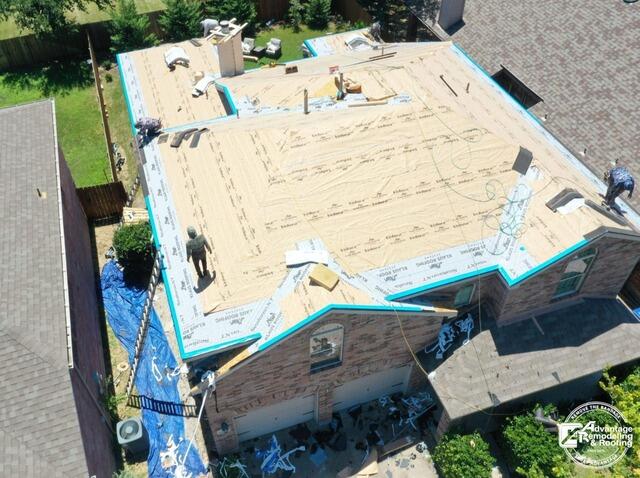
In the Before image, the project is already well underway. Most of the visible roof is covered by a light-colored preparatory surface, and several workers can be seen on different sections of the roof. Bright edging is visible around much of the perimeter, and project materials are present near the house below. Because the original finished roof surface is no longer covering the planes, the geometry stands out clearly: hips meet broad slopes, smaller roof sections connect to the main mass, and several penetrations interrupt the otherwise continuous fields.
That view should be read carefully. The photograph confirms an active roof replacement stage, but it does not by itself establish the exact material being installed, the condition of hidden components, or the reason the project began. What it does show very well is organization across a large roof. From above, a homeowner can see that replacement work has to address many separate planes while still producing one coordinated finished exterior.
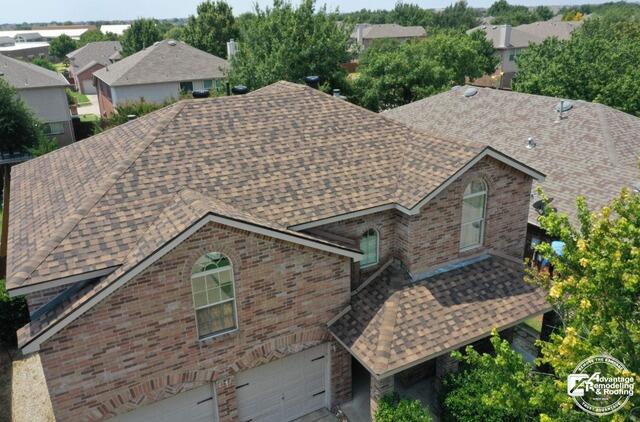
The After image provides that completed whole-house perspective. A patterned finished roof surface now extends across the large upper sections and the lower roof areas above the garage and entry. The different planes read together instead of appearing as separate construction zones. Roof penetrations remain visible, but they sit within a continuous finished field. The warm tones of the roof also relate visually to the brick façade, while trees and neighboring homes help establish the scale of the property.
For a Prosper homeowner, the biggest lesson in this comparison is consistency across complexity. From the ground, portions of a two-story roof can be difficult to see at the same time. An elevated view makes it easier to evaluate whether the visible roof presents a coherent appearance from one side of the structure to the other. Hips, changes in elevation, roof-to-wall areas, and smaller projecting sections can all affect how the finished work looks even when no single detail dominates the façade.
The Before image also illustrates why progress photographs can be valuable during a major exterior project. A homeowner does not need to make technical conclusions from a photograph to benefit from seeing the work at different stages. Images can document what areas were open or covered, where crews were working, and how the roof looked before the final surface was in place. The completed aerial image then gives a broad reference for the visible result.
There is also a neighborhood-scale element to this Prosper project. The aerial photographs show adjacent houses, mature trees, fences, and backyards surrounding the property. That context makes the roof's size and visual presence easier to appreciate. A roof replacement changes one of the largest exterior surfaces on a home, and the effect is particularly noticeable when the entire roof can be viewed against nearby structures rather than only from a tight close-up.
This Before and After sequence succeeds because the camera angle reveals the scope visually without requiring claims that the images cannot support. The first photograph shows a multi-plane roof in an active replacement stage. The second presents the same house with a consistent finished roof extending across those interconnected sections. For homeowners researching roof replacement in Prosper, it is a strong reminder to look at the complete roof form, not just one shingle sample or one small slope, and to consider how the finished surface works with the architecture of the entire home.