Full Roof Replacement in Allen, Texas - From Leaks to Lasting Protection
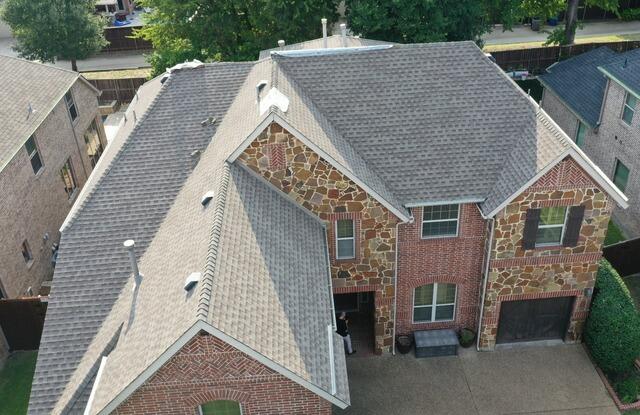
Recurring leaks had already made this Allen roof an ongoing concern before the full replacement began. Temporary patch repairs had already been used, but the leaks continued.
That background gives the aerial Before photo more meaning than a simple view of an older gray roof. From above, the roof still looks like one continuous system across several planes, yet the homeowner's experience with repeated leaking had already shown that the existing condition was not providing the long-term resolution they were looking for.
Before tear-off, the crew prepared the property for a larger roofing job. Special tarps were used to protect areas around the home, materials were delivered, and a waste trailer was positioned for the work. Those details are easy to overlook once a new roof is finished, but they were part of the preparation for this full replacement. A full roof replacement creates a temporary flow of old material coming down and new material going up, so site organization becomes part of how the project moves from the existing roof to the completed one.
The roof itself has multiple visible planes, which makes continuity especially important in the finished view. Valleys, ridges, and changes in direction break the roof into sections, but a complete replacement has to read as one coordinated surface across all of them. The Before aerial provides a useful map of that geometry. It shows the shape that remains constant while the roofing material changes, allowing the final image to be compared plane by plane rather than only by color.
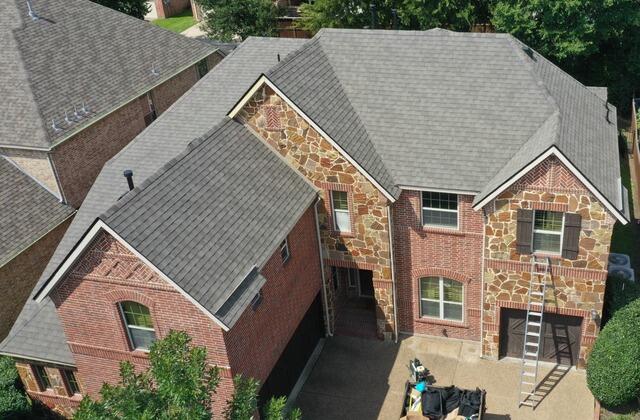
After the old roof was removed and the replacement work was completed, the aerial After photo shows the same Allen home with a darker renewed roofing surface. The footprint, rooflines, and surrounding property make the identity unmistakable.
What changes is the appearance of the roof itself: the older gray field gives way to a darker, more uniform finish that follows the same complex layout. Because the work was roof-wide rather than another isolated patch, the result is visible across the entire aerial view.
Cleanup closed out the project after installation. That matters on a replacement because the work affects more than the roof deck while it is underway. Packaging, removed roofing, delivery materials, and other jobsite items have to be managed around the property. The final state is therefore not only a completed roof overhead but also a house that has moved beyond the temporary construction setup. The waste-handling and cleanup details help connect the preparation stage with the finished aerial photograph.
For homeowners who have lived with recurring leaks, there can be a practical difference between another temporary repair and deciding to replace the broader roof system. At this Allen home, recurring leaks and prior patching led to a roof-wide replacement instead of another small repair. Here, repeated problems and prior patching were already part of the home's history, and the homeowner chose a full replacement. Readers exploring roofing work in Allen can see how that larger scope changed the visual character of the entire roof.
The project also shows why aerial photos are useful on homes with several intersecting roof sections. A ground-level picture may emphasize only the front slope, while the overhead view reveals how much roofing is actually connected across the structure. In this case, that broader perspective makes the difference between patch work and full replacement easier to appreciate. The darker completed roof is carried across the visible planes instead of appearing only around one previous leak location.
Other roofing transformations may begin with storm damage, age, or a different project need. This Allen home is distinguished by recurring leaks, earlier temporary patches, deliberate site preparation, a complete reroof, and cleanup. The two aerial views provide a clean bookend to that work: an existing gray roof over the multi-plane home at the start, followed by a darker renewed roof covering the same geometry after the replacement was complete.