Roof Repair Before & After Photos
Click on a photo to enlarge.
Emergency Roof Repair in Prosper TX


An active leak made timing the central issue at this Prosper home. The homeowner called in the morning, and the crew was on the roof by lunchtime.
That same-day response separates this service call from a planned reroof or a cosmetic maintenance visit. Water was already getting through, so the immediate job was to inspect the roof area and perform localized emergency work rather than schedule a broader project weeks later.
The Before photo is a close view of the asphalt-shingle roof. Several dark or missing-looking rectangular areas appear near roof penetrations and ridge features, and the project notes describe several potential leak locations after a storm. Those visible areas create a concentrated field of concern instead of one obvious hole. Homeowners dealing with an active leak can find relevant service context through roof repair, but this Prosper job stays focused on the specific localized conditions photographed that day.
The After image shows multiple rectangular silver-blue patches covering several spots on the same roof area. Their shape and color make the repair locations easy to identify.
That is important because the finished condition is not being presented as a full roof replacement. The roof around the patches remains in place, and the work visible in the photo is concentrated at individual areas where emergency repair was performed.
Emergency roofing often looks different from a planned replacement in Before and After photos. A full reroof can change every visible plane, while localized work may leave most of the existing shingles unchanged. The transformation is therefore smaller but still meaningful. Here, the visual difference is the addition of patch materials at several roof locations, matching the immediate goal of responding to active water entry.
For a homeowner, the first indoor sign of a leak does not always reveal the exact exterior entry point. Roof penetrations, transitions, and nearby surfaces may all need attention during an inspection. This project's notes mention several potential locations following the storm, which helps explain why multiple patches appear in the After image. At this home, several potential locations were identified, which is why the After photo contains more than one localized patch.
The same-day timeline is also easy to understand in practical terms. A morning call followed by roof access around lunchtime means the service was organized around an immediate problem already affecting the home. The morning-to-lunchtime sequence gives Prosper homeowners a concrete view of how quickly this crew responded once the active leak was reported.
Another useful feature of the photos is their close scale. Instead of stepping back to show the entire house, the camera stays near the repaired roof area. That makes individual patches visible and keeps the work from being mistaken for a more extensive replacement. The image pair therefore matches the scope well: several local areas before repair, followed by several local areas with patch material installed.
The silver-blue repair material is visually unmistakable against the existing shingles, which is useful for understanding scope. Rather than trying to make the emergency work disappear in the photograph, the After view makes each treated location easy to trace. A homeowner can see where the crew concentrated its immediate work and how those locations relate to nearby penetrations and ridge features on the same roof section.
More Before & After roof projects may show full tear-offs, new shingles, or other types of work. This Prosper project ends differently. The roof remains largely recognizable, while the emergency repair locations are clearly marked by the new patches. From active leak to same-day roof work, the project clearly ends with several visible localized patches across the affected roof area.
Roof Repair in Richardson, TX
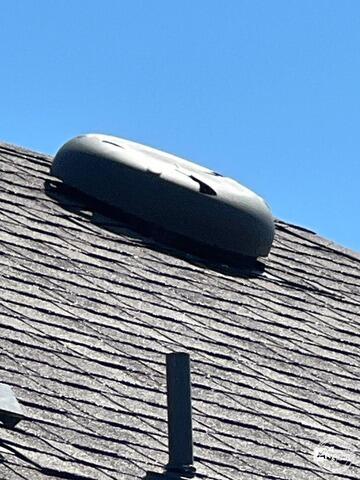
The Richardson roof repair Before and After set tells a different kind of project story because the second photograph is not a polished, distant view of a completed roof. Instead, both images stay close to the roof surface and document specific areas where work is concentrated. In the Before view, a large dark roof-mounted housing sits on the shingle slope, with a visibly lifted or open section along its upper surface. A smaller vertical pipe is also visible lower on the roof. The photograph establishes the location and the visible condition of the rooftop component, but it does not establish why that condition developed or whether it caused any interior problem.
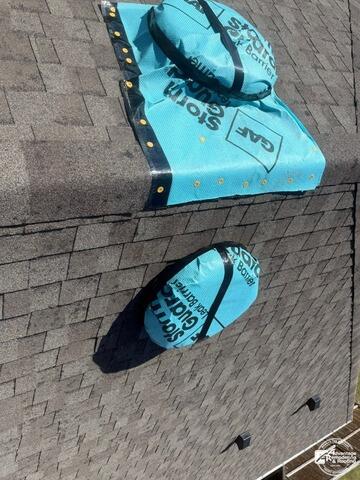
The page-labeled After photograph shifts to a higher overhead angle. Two distinct areas on the shingle field are covered by bright blue sheet-like material, one larger and rectangular near the upper part of the image and another smaller area lower on the slope. Their edges are clearly defined against the surrounding shingles. This image is valuable precisely because it appears to document a repair stage rather than trying to make the project look finished before the work shown in the photograph is complete. It gives homeowners a closer look at where attention was focused on the roof.
That difference in image type makes this Richardson case study useful. Some Before and After sets are mainly about curb appeal; this one is more about documentation. A homeowner can see a rooftop feature in the first photograph and then see two clearly marked work zones in the second. The pictures do not provide enough evidence to name every component or hidden layer, and they do not need to. They show that roof repair can involve small, defined areas where roofing meets a penetration or mounted element rather than a broad change across the entire house.
Roof penetrations and mounted roof components are generally worth careful attention during a repair conversation because they interrupt an otherwise continuous roof plane. Homeowners do not need to diagnose those details from the ground. What is useful is knowing where to ask questions and what photographs to request. Close views can show the contractor’s work area, nearby shingles, the shape of a rooftop component, and changes made during the project. That kind of documentation helps a homeowner follow the visible progression without relying on assumptions about hidden conditions.
The Richardson images also demonstrate why a repair record can include intermediate stages. When a photo is taken while a work area is still covered or open, it may look less attractive than the final roof, but it can be more informative. The blue coverings in the second image are easy to distinguish from the existing shingles, which makes the boundaries of the work zones obvious. A later finished photograph would answer a different question about final appearance; this pair is strongest as a record of where repair activity occurred and how those areas relate to the surrounding roof surface.
For someone considering roof repair in Richardson, that is an important distinction. A useful contractor conversation can separate visible observations from conclusions that require closer inspection. From these photographs, a homeowner can reasonably observe the lifted/open portion of the dark roof-mounted housing, the nearby shingle field, the second roof penetration, and the two later work zones. The images do not prove a storm event, leak, hidden damage, product choice, or long-term result. Keeping those categories separate is what makes project photography genuinely informative rather than promotional.
This Richardson roof repair ultimately provides a compact lesson in documenting targeted roofing work. The first image identifies a visible condition around a rooftop feature; the second records clearly bounded areas during a later work stage. Together, they give homeowners a practical visual reference for asking about repair location, surrounding shingles, roof penetrations, and follow-up photographs. The value of the project is not a dramatic exterior makeover. It is the ability to see where the roof received focused attention and to understand why close, step-by-step photos can be useful when evaluating a localized residential roof repair.
Roof Repair in Wylie, TX
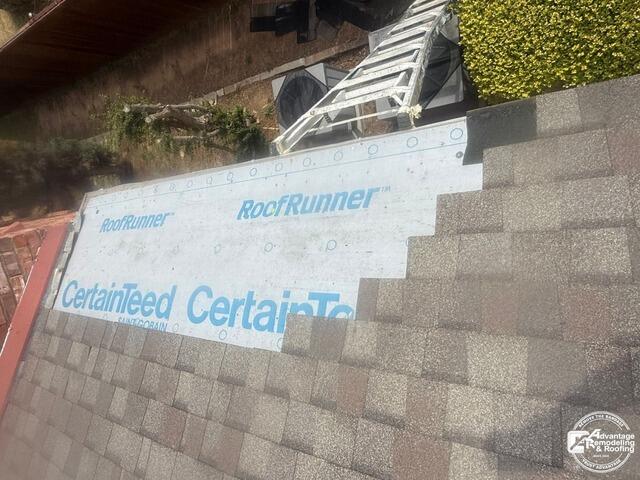
This Wylie roof repair is documented at close range, with the camera looking down across a sloped section of shingle roofing beside a brick wall. The Before image is especially useful because it captures the area while work is underway rather than showing only an unknown pre-repair condition. A rectangular portion of the roof surface is open, a light-colored sheet is visible within that work zone, and the surrounding shingle courses stop in stepped edges around it. A ladder and landscaping beyond the roof edge place the work in a normal residential setting. Nothing in the photograph establishes why the section was opened, so the most reliable story is the visible one: a defined roof area was being worked on and later returned to a continuous finished surface.
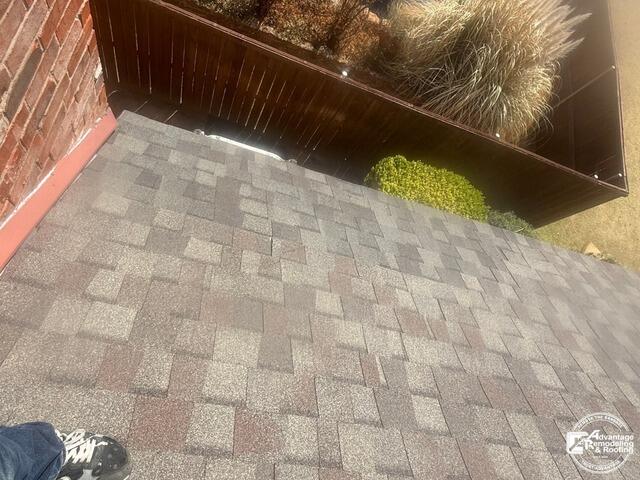
The After photograph shows the same general part of the roof with the open section no longer visible. Shingles extend across the repaired area in an orderly field, and the roof again reads as one connected surface as it approaches the brick wall and the dark overhang above. Because this is a localized view, the comparison is not about changing the appearance of the entire house. It is about how a smaller repair area fits back into the roof around it. That distinction matters for homeowners considering roof repair in Wylie, because many roofing projects are focused on one section rather than a full replacement of every visible slope.
A close-up Before and After pair can reveal details that a street-level photograph would miss. In the first image, the stepped edges of the surrounding shingles make the boundaries of the work area easy to follow. In the second, those boundaries are much less visually prominent because the shingle pattern continues through the same portion of the roof. For a homeowner reviewing repair photos, that continuity is one useful visual checkpoint. The goal is not to guess what is underneath from the finished picture, but to see whether the repaired area appears integrated with the visible roof surface around it.
The location beside a vertical brick wall also gives this project a practical architectural context. Roof sections that meet walls, overhangs, or other exterior features have more visual transitions than an uninterrupted open slope. In general, those intersections are worth looking at carefully when discussing a roof repair because the contractor has to work within the existing geometry of the home. Here, the photographs let a homeowner see the repair area in relation to the brick, the roof edge, and the nearby structure without requiring unsupported assumptions about concealed materials or the reason the repair was needed.
Another useful part of this Wylie project is that the Before image makes the temporary condition of repair work visible. A roof can look less finished while a small area is open, even when the final scope is limited. Homeowners often benefit from project photos that document that intermediate stage because they create a record of where work was concentrated. The After image then provides a simple visual endpoint: the open rectangle is gone, the surface is covered, and the shingle field appears consistent across the photographed area. Those observations are concrete without pretending that a photograph alone proves waterproofing, hidden repairs, or long-term performance.
For homeowners comparing roof repair options in Wylie, this project is a good example of why useful Before and After documentation does not have to be dramatic. The strongest evidence is the clear change within one focused roof section and the way that area visually rejoins the surrounding shingles. When reviewing a similar repair, it is reasonable to ask for photographs of the work area before, during, and after the job, then compare visible alignment, surface continuity, edges, and nearby exterior transitions. This pair offers exactly that kind of grounded project record: a localized area shown open during work and then shown as part of a finished, continuous roof surface.