A roof concern that becomes quiet after temporary work and later returns creates a useful comparison. The quiet period shows that something about the observed condition changed. The recurrence shows that the question deserves to be reopened. Neither fact, standing alone, proves the original cause or determines the permanent scope.
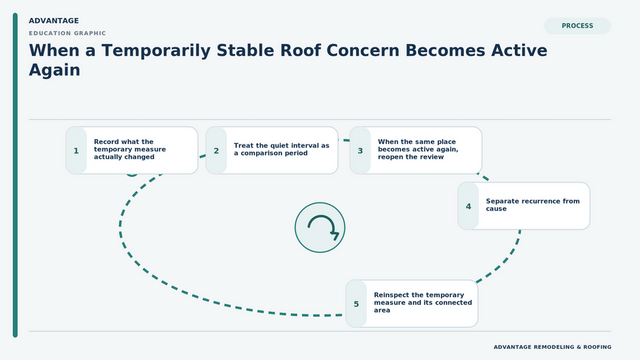
Record what the temporary measure actually changed
Start with the condition immediately before the temporary work: location, date, visible symptom, and any safely observable connected evidence. Then record the temporary measure itself and what it was intended to address. Keep the language narrow. A tarp, seal, temporary covering, or other stabilization step should be documented as the work that was performed, not as a final diagnosis.
If an area was concealed by the temporary work, preserve the pre-work photographs and notes. Later reviewers may need them because the original surface is no longer visible.
Treat the quiet interval as a comparison period
When the symptom stops appearing, add that interval to the record. A quiet period is meaningful because it can be compared with the periods before and after it. It does not establish why the symptom became quiet, whether every connected condition changed, or whether a concealed issue was resolved.
The most useful quiet-period note says what was monitored and for how long, not “problem solved.” That wording leaves room for later evidence without forcing the homeowner to undo an earlier conclusion.
When the same place becomes active again, reopen the review
Same-location recurrence is a practical trigger for reinspection. Compare the returning condition with the original baseline: is it in exactly the same place, similar in appearance, more extensive, less extensive, or connected to a new observation? Add the date and any relevant weather context, but do not let timing substitute for property evidence.
If the location is different, record it as a new location first. The inspection can decide whether the two observations are connected.
Separate recurrence from cause
A returning symptom can support the statement that the condition is active again. It does not, by itself, establish that a storm caused it, that temporary work failed in a particular way, or that a specific permanent repair is required. Those questions depend on the observable property condition and any qualified evaluation needed to interpret it.
When a symptom appears at a different location, compare it with the way Plano storm-damage problems can expand after weather clears before deciding the observations are connected. Use a clear inspection-to-completion communication record to keep the old and new locations distinct, and check the roof materials and system connections if the possible link depends on a shared component or transition.
Other possible sources should remain in their own lane until evidence narrows them. Areas that remain concealed or unsafe to access remain unknown.
Reinspect the temporary measure and its connected area
A useful reinspection asks what changed at the temporary measure, immediately around it, and at any connected interior or attic locations that can be evaluated safely. The purpose is to compare conditions, not to search only for evidence that supports the original theory.
If the new inspection reveals a material fact that changes the scope question, document that fact before comparing permanent options. This protects the homeowner from evaluating a revised proposal against an outdated description of the property.
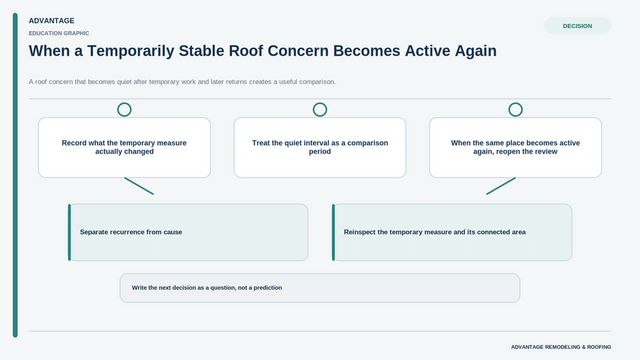
Write the next decision as a question, not a prediction
At the end of the reinspection, the homeowner should know what has to be answered next. It might be whether another area needs access, whether a material or interface needs identification, whether the permanent scope should change, or whether another responsible party must decide a separate issue.
Manufacturer, insurer, engineering, official, and owner decisions stay with those parties when applicable. The recurrence record can make their questions more specific without supplying their answers.
Compare three snapshots instead of one before-and-after pair
Temporary work often deserves three snapshots: immediately before the measure, during the quiet period, and after recurrence. Each snapshot should use the same location reference and describe only what is observable at that time. This makes change visible without requiring the homeowner to decide why the change occurred.
The middle snapshot is important. Without it, the record can make the story look like one continuous problem. With it, the reviewer can see that the observable condition changed for a period after the temporary measure. The third snapshot then shows what returned and whether it returned in the same form.
If the recurrence differs materially from the original symptom, note the difference. A changed pattern may call for a wider or different inspection question. If the recurrence is in a new location, keep it separate until the relationship is evaluated. The three-snapshot method gives the permanent-scope discussion a more accurate sequence than a simple statement that “the leak came back.”
When comparing the snapshots, use the same photograph angle or location reference when practical. Consistency makes subtle change easier to see and reduces the chance that a different viewpoint will be mistaken for a changed condition. If the old viewpoint cannot be recreated safely, note the limitation rather than forcing a visual comparison that the record cannot really support.
Use future recurrence as a defined trigger
If the condition is stabilized again, agree on what will cause another review: the same symptom returning, a new connected observation, a change after later weather, failure of the temporary protection, or newly available access to a concealed area. A defined trigger prevents both unnecessary alarm and long delays after meaningful change.
Temporary stability is therefore best understood as one period in a sequence. The homeowner gains more from comparing the before, quiet, and recurrence periods than from treating either quiet or recurrence as a final conclusion. The record stays accurate, and the permanent decision can follow verified findings instead of assumptions.